
With the coming of cooler days, getting ready for a return to more inside dining is an annual practice in the foodservice business. Autumn is a time to begin scaling back patio operations and introducing more menu items that use the bounty of the harvest to best advantage.
It’s also a good time to review operational procedures, says consultant Lionel Morey of Vancouver Island Hospitality Consulting. “Why not initiate a conversation with your trusted foodservice rep to pick their brain on trends, ideas, or new products? I spoke to a manager who was thrilled his rep mentioned transitioning them away from liquid fuel-based votive inserts for their tables to rechargeable ones – an upfront cost that paid for itself in less than one winter.”
The end of summer usually means big staffing changes, too, as many employees head back to school or embark on other life changes. Look carefully at how many team members you will need based on your sales projections and then determine how many you need to hire and when you need to start training them. Slightly shorten shifts to retain more key staff over the downtime and avoid paying overtime.
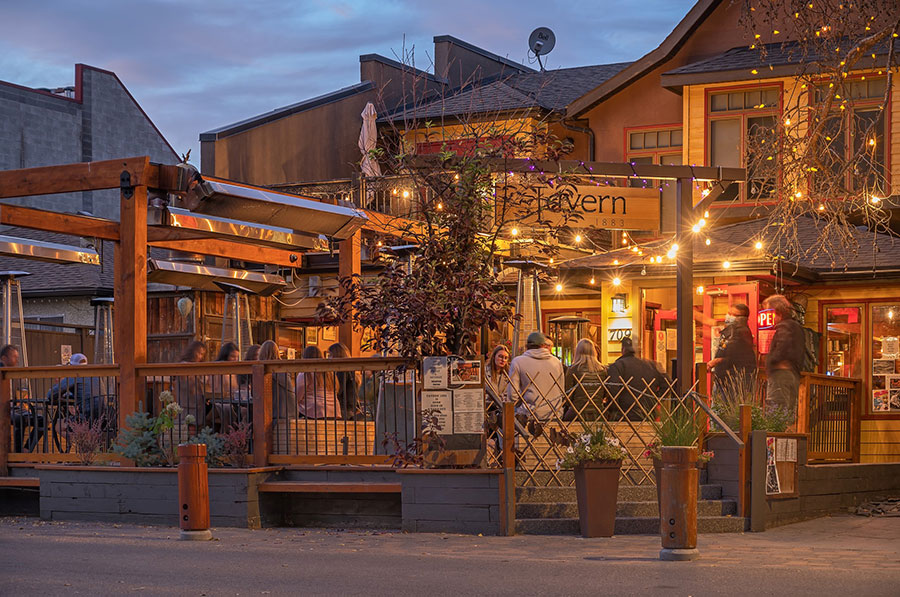
Restaurant patio’s winding down, now what?
Create a checklist of what needs to be done for winter storage for the furniture, flower pots, and outdoor host stands/bars/side stations. “I have a client who donates the flowers to a local seniors’ facility who has room for them and she picks them up in the spring – a win-win! Just remember for the furniture to check the manufacturer’s specs on cleaning and storage, and a basic rule of thumb is clean/dry/stack/store ideally in a warm, moisture controlled room,” Morey says.
Consider a covered and heated patio. It’s a great way to attract those guests not ready to return indoors, says Jenny Companion, VP eastern operations for hospitality consulting agency The Fifteen Group. “It also provides more options for operators should there be any changes to indoor dining restrictions.”
If your traffic slows in the fall, the season is a perfect time to schedule a deep clean and complete repairs, upgrades and seasonal maintenance. Consider smaller details, too, like updating your music playlist, auditioning live entertainment, and trying out an alternative seating plan.
Change is in the air
Fall may be the perfect time to consider changes to seating styles and layouts, Companion says. “Replacing fixed seating with more flexible chairs and tables may be a good way to accommodate more guests and a smart investment for the fall and cooler temperatures when guests choose the indoors. Being flexible should restrictions change will be an asset for operators.”
“Replacing fixed seating with more flexible chairs and tables may be a good way to accommodate more guests and a smart investment for the fall.”
Jenny Companion, VP eastern operations, The Fifteen Group
Now is also the time to start thinking about the return of large groups and holiday season celebrations, Companion says. “Being prepared is the key to selling this type of business and capitalizing on opportunities.”
Showcase the bounty of the harvest
It’s never too early to start planning a fall menu built around some key considerations:
- Locally/regionally-sourced fruits and vegetables, the essence of fresh and good.
- Comfort food classics like mac and cheese.
- Desserts loaded with fruits of the season – pies, puddings, cobblers, and more.
- Incorporating savoury spices that warm and wow.
- Announcing your fall menus on social media.
Don’t forget that a $3 head of cauliflower turns into a $7 head in January, so sharpen your pencil and cost out with the peak numbers you’ll be seeing. “Involving your suppliers in these conversations can save a lot of grief,” Morey advises.
Recharge!
If you are a seasonal operation and fall and winter are your downtime, take the opportunity to find that elusive work/life balance. “Send your chef on an R&D trip to see what’s hot, plan that management getaway that’s heavy on fun and light on work, and just step away from your business as much as possible to diminish the fatigue and burnout so often associated with restaurants,” says Morey.
Let loose a little
Prepare for the days (and nights!) when restrictions are lifted and people are allowed to gather indoors again. Pubs have success with open mic night or a comedy show, diners have quirky promotions that guests love like “flip a coin and you pay double or nothing,” or do food challenges, Morey says.
“Upscale cocktail lounges can offer a “dealer’s choice” drink special or feature industry experts for a fun night of Q&A with guests or more typically other industry folks. Late night offerings are rapidly growing as well so let your teams involve the more junior staff in these promotions and they benefit from both the experience and camaraderie – a real team building exercise.”
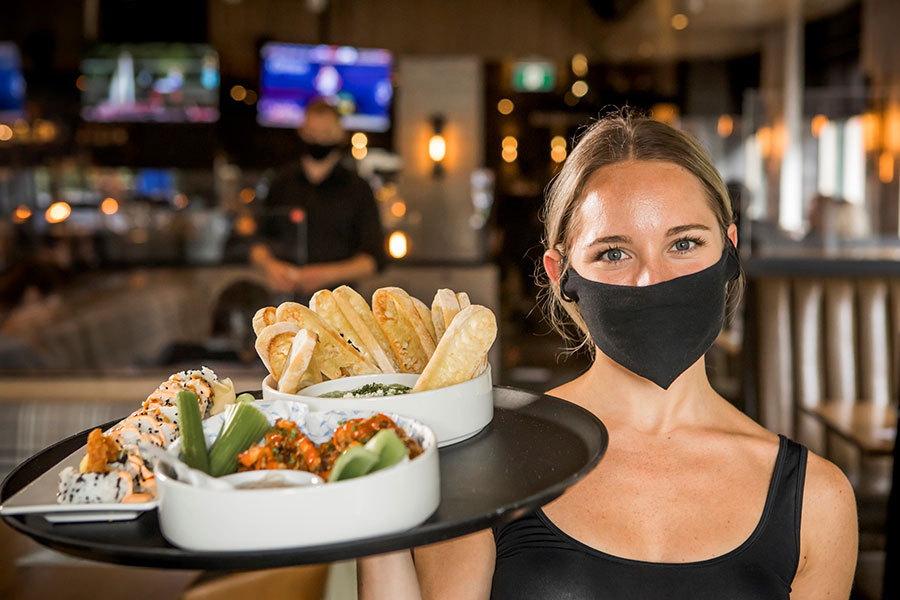
COVID-19 considerations for restaurants
With COVID-19, there’s a lot more to consider, and careful planning and attention to detail are even more crucial.
- Various health bodies including the Canadian Centre for Occupational Health and Safety recommend that all customer parties remain at least two metres (six feet) apart. Where that is not possible, certain tables and chairs can be marked as unavailable for use.
- Where practical, separate booth seating with physical barriers such as clear acrylic plastic or plexiglass. Temporary table dividers may be installed to make social distancing easier for restaurants with communal seating or larger tables.
- Create separation from action stations or open kitchens. Separate guests from the kitchen or plating team with high, clear dividers if the distance between guest and staff is less than two metres.
- Install physical barriers, such as sneeze guards and partitions, particularly in areas where it is difficult for individuals to remain at least two metres apart. Barriers can be useful in restaurant kitchens and at cash registers, host stands, or food pickup areas where maintaining physical distance is difficult.
- So that people can speak as quietly as possible and reduce aerosol transmission, reduce noise levels as much as possible including turning off or down the volume of background music. Suspend live music and performances.
- Configure order pick-up areas in such a way as to provide the greatest possible distance possible (minimum two metres) between guests and employees. Use floor markings for clarity.
- Modify payment pads to have long handles to help employees and guests maintain greater separation.
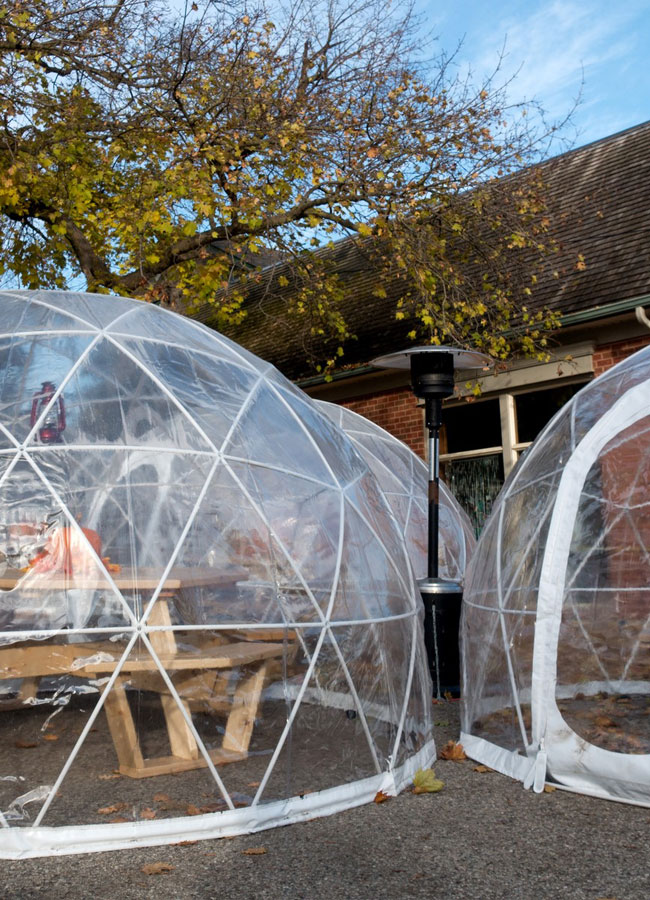

Thinking ahead
- Offer drive-through, curbside takeout, or delivery options as applicable.
- Ask customers to wait in their cars or away from the establishment while waiting to pick up food or when waiting to be seated.
- Discourage crowded waiting areas by using phone app, text technology, or signs to alert patrons when their table is ready.
- Consider options for dine-in customers to order ahead of time to limit the amount of time spent in the establishment.
- Provide a weather permitting overflow waiting area outside, if possible.
- Replace traditional menus with easy-to-disinfect, laminated menus or replace them with one-time use paper sheets.
- Temporarily suspend self-serve options that require using shared utensils such as salad bars, breakfast bars, or buffets.
- Provide physical guides, such as tape on floors or sidewalks and signage, to ensure that individuals remain apart, especially where lines form.
- Have cutlery, condiments, napkins, and other items behind a counter and available upon request instead of in communal dispensers.
Masking
Health and safety remain very important in the consumer’s mind. It’s important to follow provincial and municipal guidelines and to post and communicate your actions to your customers, Companion says. “Beyond that, the key importance is to stay diligent with enforcing these restrictions for the safety of your staff.”
The CCOHS recommends that all foodservice operators implement a mask-wearing policy. Require employees to properly wear well-constructed and well-fitting masks. Masks should cover the nose, mouth, and chin without gaps.
Vaccines
- Encourage employees to get the COVID-19 vaccine as it is eligible and available in your jurisdiction.
- Share additional information on the vaccine by posting it on your premises or sharing it electronically.
More COVID resources:
- Restaurants Canada COVID-19 Rapid Recovery Guide
- CCOHS COVID-19 Health and Safety Resources – Restaurants
- CDC’s Considerations for Restaurant and Bar Operators
If you can remember Encyclopedia Britannica, Swanson TV dinners, party lines, TV converter boxes, banana seat bicycles, transistor radios, the Sears Wishbook catalogue, and the last Stanley Cup parade in Toronto, then you’re a Baby Boomer or the parent of one.
Baby Boomers remain, according to Statistics Canada, the most significant age group in Canada. They are, however, approaching a tipping point. At some point in the not too distant future, the Baby Boomer market segment (born between 1946 and 1964) will no longer be the largest market segment by population. It’s inevitable that Millennials will overtake Boomers in sheer numbers. But that doesn’t tell the whole story.
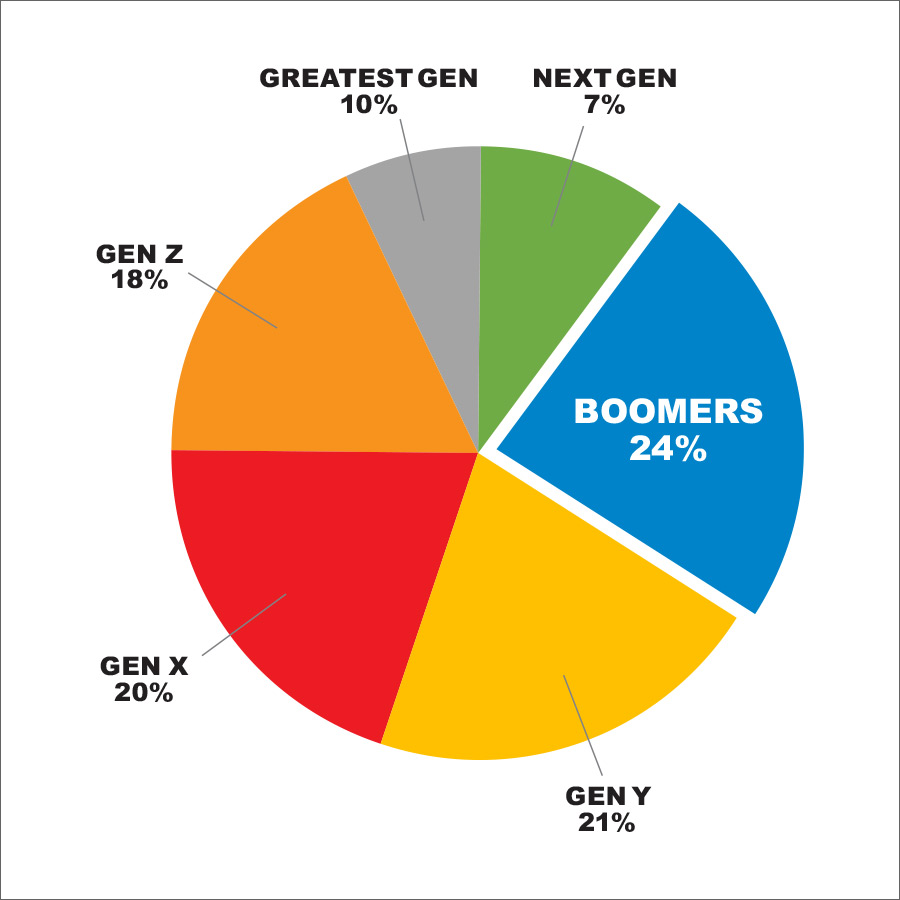
Meet Canada’s generations
- Baby Boomers: 1946-1964
Back-end Boomers: Age 57-68
Front-end Boomers: Age 69-75 - Generation X: 1965 to 1979
Age 42-56 - Generation Y: 1980 to 1994
Age 27-41, often referred to as Boomers’ kids or Millennials - Generation Z: 1995 to 2010
Age 11-28, the newest generation to be named
Baby Boomers still make up the largest segment of the Canadian population. But, beyond this, they hit above their weight in terms of economic impact. Even as back-end and front-end Baby Boomers age, they will remain a consumer force to be reckoned with.
Going, going, not gone
Close to five decades years ago, fewer than one in 12 Canadians was a “senior” (65+). By the mid-1990s, that had risen to almost one in eight. In 2011, when the first of the Baby Boom generation crossed the threshold, the number of seniors began to mushroom. By 2030, less than a decade from now, nearly one in four Canadians will be seniors.
In some ways, the Baby Boomers’ golden years could be a golden age for discretionary and leisure purchases. Over half still have a household income above $60K/year, and only about one-quarter of Baby Boomer households still have kids at home who have failed to launch.
The end is not quite nigh
In Canada circa 1976, almost 12% of jobs were held by someone 55 years of age or older. Comparatively, the current participation rate has nearly doubled to 21.5%. That’s more than one in five jobs held by those who, a generation ago, were approaching or in their retirement years.
In her piece titled, “Like it or not, the Boomers are here to work,” Linda Nazareth coined the term “Perennials” to describe mature working boomers — they keep coming back every year.
This trend will likely not significantly abate in the near term. Nazareth cites the U.S. Bureau of Labour Statistics prediction that, by 2024, the over-55 cohort will be the largest segment of the workforce. Canada and other Western-developed economies will likely be in the same boat.
Not going quietly
According to Technomic’s Generational Consumer Trend Report, more than half of people (in the U.S.) between the ages of 53 and 72 use foodservice on a weekly basis.
Given their disposition to not go gently into retirement, and the purchasing power that accrues from their accumulated personal wealth, Baby Boomers are worth paying attention to.
Here are some other trends Technomic has flagged for savvy restaurant operators:
- Boomers are big flavour seekers. 66% of respondents like to explore new flavours, especially when they are added to perennial favorites, such as burgers and chicken.
- Boomers are brand loyal and enjoy patronizing their favourite restaurants. Thirty-six percent tend to visit the same few restaurants each time they go out to eat. But they also value food quality and taste more than other age groups — 70% say taste is an important menu attribute and 68% value food quality.
- Boomers like deals. 50% enjoy looking for value in their dining experiences.
- Boomers like their restaurants clean. 63% of boomers say cleanliness is a very important feature in restaurants, especially as it applies to clean bathrooms and utensils.
The challenge for marketers is to provide what Boomers want as their needs evolve in the back furlongs of their lives. There’s a tendency to shift from conspicuous consumption to more experiential consumption.
While, overall, Baby Boomers’ appetite for conspicuous consumption may be waning, travel, leisure, and foodservice spending remains a priority. This holds for both Baby Boomers in retirement and those still in the workforce.

Baby Boomer eating habits are changing
How have Baby Boomer tastes and eating habits changed over the past two decades? The NPD Group has a number of survey instruments that track historical food consumption of Canadians at home and away from home.
Compared to the beginning of this century, Baby Boomers have markedly shifted their food consumption:
Eating more:
- Better-for-you foods – yogurt, RTE cereal, hot cereal, fish and vegetables
- Front-end Boomers are more likely than Back-end Boomers to choose special labels like “all natural,” “cholesterol free,” “low fat” and “no artificial sweeteners”
- Special labels at breakfast, such as “low fat/diet/light,” “whole grain” and “vitamins added.”
Eating less:
- Family friendly, less nutritious foods – waffles, pancakes, hot dogs and French fries.
Limiting the meat:
- Dr. Sylvain Charlebois, Project Lead, Institute of Agrifood Analytics at Dalhousie University, has data confirming the finding that Baby Boomers are eating less meat.
Overall, Canadian beef consumption is down by 16% or 94 million kilos per year, compared to 2010. Over six million Canadians have either adopted a meatless diet or are have adopted a “flexitarian” lifestyle, limiting the amount of meat they eat every week, AND, nearly a third of Canadians are “thinking about” reducing meat consumption in 2019.
While this trend noticeably skews to younger consumers, more than 42% of flexitarians are Boomers, who view reduced meat consumption as a healthy choice.
The bottom line?
For the first time in its history, as of 2017, Canada had more residents 65+ than children 14 years or younger.
Time will continue to march for Baby Boomers who remain working, and those participating in society in other ways. But, just as they demanded attention when they first came of age, aging Baby Boomers will reward restaurant operators who hear them.
So, it makes good sense, and will make for good business, to keep the specific likes and dislikes of this demographic multitude in mind to keep fueling the growth of your foodservice operation.
Meet your Baby Boomer diners
Factors driving Baby Boomer food choices and restaurant visits

- Flavour seekers
Boomers enjoy trying new flavors in familiar foods – 66% of respondents like to explore new flavors. - Brand loyal
Thirty-six percent tend to visit the same few restaurants each time they go out to eat. - Quality and taste
Boomers index food quality and taste more than other age groups — 70% say taste is an important menu attribute and 68% value food quality. - Deal or no deal
Along with taste and quality, price turns the dial for Boomers. Gen Xers are the most likely to seek deals and discounts at restaurants (55% say they do so), baby boomers come in a close second at 50%. - Flexitarians
Few Boomers are full-time vegetarians BUT more than 50% say they plan to increase their consumption of fruits and vegetables. - Cleanliness matters
Restaurant cleanliness matters to Boomers, with 63% saying it is a very important attribute. - Picky about takeout
Order accuracy is a top priority to 70% of baby boomers, and 75% expect the food quality and taste to be as good as it is when dining in the restaurant. Convenience is not as important to this generation as it is to millennials and Gen Zers. - Personalized service
Boomers are less likely to order from a mobile device or app. Boomers still value customer service in casual dining. - Cash is king
Not fans of cashless operations and kiosk ordering at QSRs and restaurants.