
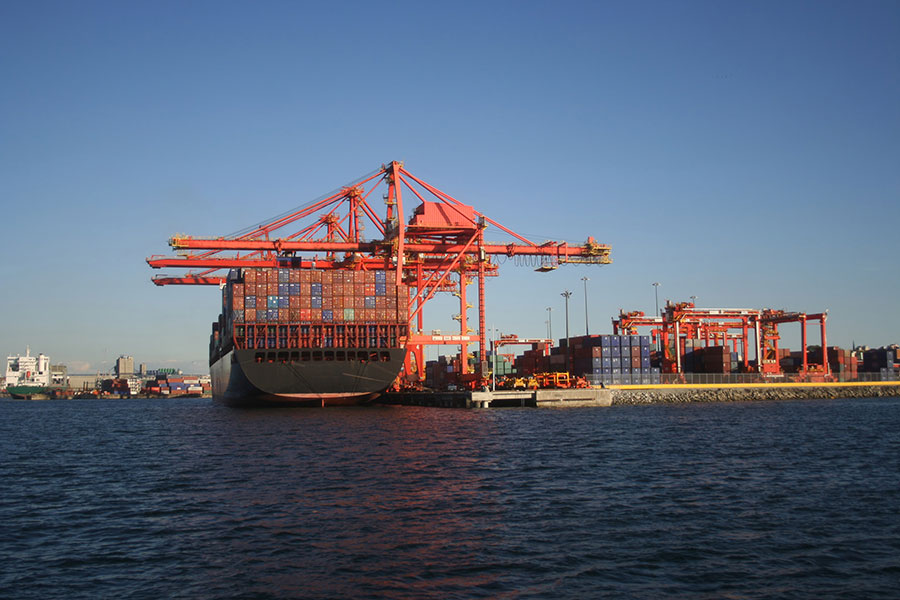
The COVID-19 pandemic has placed unprecedented stresses on supply chains worldwide. Policies adapted to contain the spread of the virus have contributed to bottlenecks in farm labour, processing, transport and logistics and momentous shifts in demand, according to the OECD. Factory shutdowns and slowdowns, staff shortages, congested shipping routes and lean manufacturing with low inventories have all contributed to major obstructions at each stage of the supply chain.
As some shipments are delayed or unavailable, foodservice operators are adapting and embracing flexibility. With recent storms knocking out primary supply routes, operators in B.C. and Newfoundland in particular have had additional challenges to face that exacerbate supply chain challenges.
“Buy what you need … and trust the system. The long-term goal of sourcing locally-made ingredients that are plentiful is the best way to shelter your business from disruptions.”
Peter De Bruyn, provincial chair of the BCRFA
Peter De Bruyn, provincial chair of the BCRFA, says the best way for foodservice operators to get through this is to “buy what you need, not necessarily overbuy, and trust the system. The long-term goal of sourcing locally-made ingredients that are plentiful is the best way to shelter your business from disruptions.”
Experts recommend that foodservice operators focus on what they can control. That means nurturing strong (and local, when possible) partnerships, creating flexible menus that can be easily adapted, working out dish substitutions in advance, and keeping the lines of communication open with your staff, customers, and suppliers.

Building relationships to enhance supply links
- Maintain good relationships with your suppliers to ensure adequate warning of any shortages or even price increases.
By working with your foodservice distributors, operators can be better positioned to alleviate the impact on their business. “The supply challenges we have all faced have made the communication between operators and suppliers that much more important,” says Jason Voisey, purchasing manager at F. J. Wadden and Sons, based in Mount Pearl, Newfoundland.
“When distributors communicate any supply issues to their operators as soon as possible, the operator can adjust or modify menu plans,” he adds. “Addressing the circumstance early and working closely together helps ease the frustration and improves the relationship.”
Tips to streamline your menus and simplify kitchen operations
- Pay attention to which menu items are most impacted by restaurant supply chain issues.
- Remove them or offer them as features when ingredients are available.
- Reduce your number of items to those you are confident you can deliver for guests that day.
- Be ready to adjust menus on short notice.
- Make regular items feature items until ingredient supply returns to stability.
- Ensure your menu prices can absorb small increases from rising costs.
- Pay attention to how today’s events will affect next week’s menu…and beyond.
Be flexible to achieve results
- Build greater efficiency and stability of supply and don’t run out of menu items nearly as often.
During these challenging times, being open to more generic products adds flexibility, Voisey advises. “Each operator has preferred products that they would like to use. By working with their distributors to understand which products are available, operators can find suitable alternatives. This may impact some recipes and plate profiles, but it can help keep items on the menu and avoid guest disappointment.”
Suppliers may have several SKUs of similar products, and while some work well, others don’t, De Bruyn says. “Know what items you can easily substitute while you wait for your main supply to return.”
Managing expectations is important, adds Sylvain Charlebois, director, Agri-food Analytics Lab at Dalhousie University. “We are already seeing menus shrinking as well, which is not a bad strategy. Less could and will likely be better in the future, from a supply chain perspective.”
Carrying extra inventories can help get through the current challenges, Voisey says. “But equally, distributors have to monitor their carrying costs and cash flow closely.”
Assess your risk and plan ahead
- Update your emergency plan to include the learning from this pandemic and supply disruptions.
Audits and stress tests will become more critical for companies, Charlebois says. And more supplier options will also be critical if the company experiences a breach of some sort across the supply chain.
“Most companies have an emergency plan, but most did not include a strategy for dealing with a pandemic. Cybersecurity is another issue most companies will need a plan for, and that plan needs to be linked to the supply chain.”
Technology can help
- Online ordering systems, sales trackers and target marketers can mitigate restaurant supply chain impacts.
Using technology by tracking sales helps the foodservice operator make more informed decisions when it comes deciding if an option should be kept on the menu, Voisey says. “Focusing on the most popular items and working with the supplier to ensure these items are available allows the operator to focus on what they can sell and not what is unavailable.”
Data and technology are more important now than ever, and we generally have great access to it, De Bruyn says. “Most of us have point-of-sale systems; as well, we may have the data from our third-party delivery companies. This data can help us understand not only what products consumers are buying specifically, but what trends exist with purchasing behaviour. In times of supply shortages especially, there is no benefit to investing extra labour sourcing ingredients for a low-selling menu item.”
The use of more predictive analytics and forecasting are great tools to understand what lies ahead for foodservice businesses, Charlebois says. “We are expecting more companies in the sector to use promising technologies offered by machine learning, for example.”
Ingredient tips
- Develop or modify menus with ingredients that are common among several suppliers.
- Use reliable ingredients in several menu items wherever possible.
- Source local ingredients from trusted suppliers or even directly from farmers.
Great idea 💡
If a popular menu item is unavailable for a time, advertise it on social media when it does return – even for just a limited time offer – to build diner excitement.
More information:
Food Supply Chains and COVID-19: Impacts and Policy Lessons
Is it all doom and gloom? According to projections by the Canadian Chamber of Commerce (based on Statistics Canada research), 60% of operators are at risk of closure by the end of 2020. Dark clouds continue to gather on the horizon: the prospect of a reduction in various government support programs; a six-month hiatus in patio dining over the fall and winter; and a likely second wave of the virus.

To better understand the mood and attitudes of Canadian consumers with respect to COVID-19, the Agri-Food Analytics Lab at Dalhousie sponsored a detailed research project conducted by Angus Reid in June 2020.
A total of 1,505 Canadians were surveyed. They were asked if they had been ordering food from restaurants during the pandemic and if they intended to return to their old habits afterwards. The survey also measured consumer expectations in terms of using foodservice in the rest of the year.
Behavioural impacts of COVID-19 — key insights
The good news
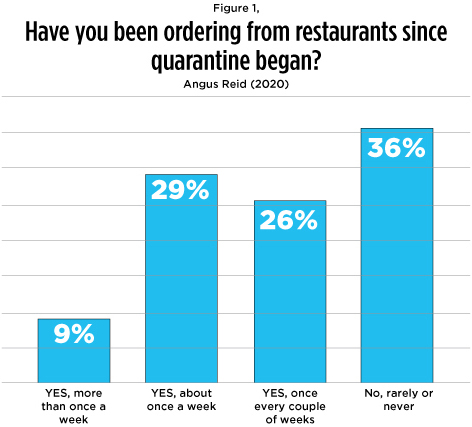
- Two-thirds of Canadians kept ordering food regularly from restaurants during the pandemic. A total of 64% of Canadians had ordered food at least every two weeks from a restaurant.
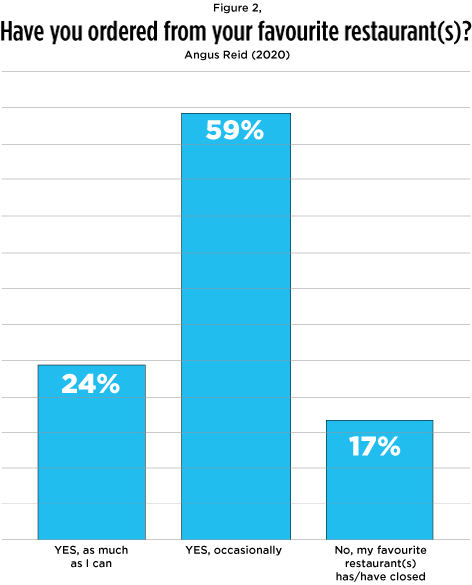
- A total of 83% of Canadians ordered from their favourite restaurant during the first three months of the pandemic.
- Younger people were more likely to order out from a restaurant. A total of 81% of respondents between the ages of 18 and 34 years old had ordered from restaurants, the highest rate among age groups.
- About 29% of Canadians ordered from restaurants at least once a week, and 9% had ordered food once a week since the beginning of the pandemic.
The bad news
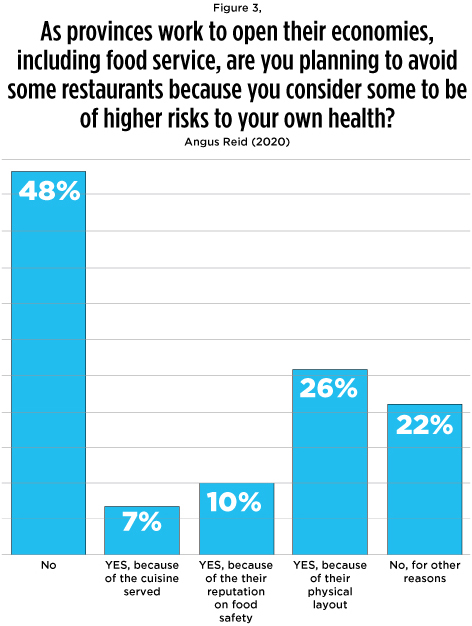
About half of Canadians were hesitant to resume restaurant patronage to protect their own health.
- Physical layout appears to be the most important issue for people.
- About 10% of Canadians say they will avoid establishments due to their food safety reputation.
- And about one-fifth of Canadians will avoid establishments for an undisclosed reason.
Bottom line for operators is the need to invest in changes to your physical environment and perceived service level to build trust. Consistency and commitment in the implementation of these changes will enable you to gain and keep consumer confidence.
Meeting and managing expectations
In the Dal Agri-Lab survey Canadians were asked what they expect to see when they return to their restaurant of choice. The overwhelming majority of respondents said they expected to see more personal protective equipment worn by staff, and measures taken to separate/protect diners (e.g. more plexiglass).
Interestingly, there was also an appreciation for the challenges faced by operators to maintain safety and manage the circumstances. Nearly 40% of Canadians said they expected slower service and 29% expect menu changes or fewer choices.
Author of the Dal Agri-Lab study, Professor in Food Distribution and Policy at Dalhousie University Sylvain Charlebois estimates that up to 30% of lost restaurant revenue in 2021 could be a result of people working from home. “The more people work from home, the less likely they are to spend money on food and beverages at local restaurants.”
“The more people work from home, the less likely they are to spend money on food and beverages at local restaurants.”
Sylvain Charlebois, Professor in Food Distribution and Policy at Dalhousie University
The road forward will depend on both governments and operators helping themselves by doing what is needed to optimize the safety of foodservice in order to convince guests that it is safe to return to restaurants.
Foodservice has already been buffeted by unparalled difficulties as a result of COVID-19. A survey of operators by Restaurants Canada at the end of March 2020 revealed that one in 10 restaurants in Canada had already closed permanently — roughly 10,000 businesses that had decided not to reopen. Charlebois adds, “We are expecting the industry to lose $20 billion, on top of what actually happened this spring. In a year from now, 25% of all restaurants will disappear.”
Though many more operators may be forced to close by 2021, the industry will endure. However, reduced meal occasions and altered consumer behaviour may be with us for the long haul.