
Family-owned businesses possess many strengths, such as their ability to look at the long-term development of their operation and align interests between management and owner.
This is especially true of “owner-operator” structures often seen with independent restaurant operators. However, restaurant owner/operators also face some challenges, such as how to objectively evaluate performance and capabilities and how best to ensure talent development within the family.
In some cases, families – despite having a common base to build on and often working together day-to-day – find it difficult to conduct conversations among themselves about important financial issues. It’s very hard to disconnect emotions and be fact-based and objective in a family business. Therefore, obtaining some external impartial support can be a source of great assistance.
According to the Family Firm Institute, 70% of family businesses will not survive into the second generation and 90% will not survive to the third generation. As well, a Canadian Business Insights study from 2021 found that “only 34% of Canadian family businesses have a robust, documented and communicated succession plan in place.”
Succession planning for family-owned restaurants need not be a frightening prospect.
Here’s how you can plan your family-based restaurant for success:
Not a one-off succession plan
The first thing to understand about succession planning is that it is not a one-off exercise, but rather a way of managing the family business professionally during the business’s lifetime. In addition, this is not only about succession at the top, but throughout your entire operation. The same issues appear across the business on all levels. Having adequate processes in place is necessary for all family-owned businesses.

Start early
Engaging family to determine their personal aspirations and wishes is no small feat. It takes time and rarely proceeds in a straight line. It’s important to start early so the family’s collective goals and values can percolate over the years and lead to a broadly accepted family vision.
In multi-generational family businesses involving various branches, it’s crucial to encourage full participation of the entire family or representatives of the various family branches. Family meetings can be a productive way to promote communication, cooperation, and, most importantly, trust. Creating a board of family advisors might be a good idea. Emotions can run high when dealing with family issues. Holding regular “check-ins” can help manage the emotions around succession planning.
Prepare for your business transition
Comparing internal factors that a family can control versus external factors that are beyond a family’s control helps the decision-making process.
Internal factors within the control of the family are: the corporate structure (including the current shareholders agreement), culture, employees, business profitability, and access to financing.
External factors include changes in competition, technology, market demand, and public policy. By blending both internal and external analysis with family member communication, it should become clear whether your family should keep the business in the family or consider selling. The family should set out steps and milestones within the framework of a strategic plan.
Prepare for your personal transition
Succession planning tends to focus on technical aspects like tax and estate, while insufficient attention is paid to planning for lifestyle balance and building a new identity post-succession.
Only in hindsight do many owners realize the impact that succession of the family business creates. Inevitably, leaving the business can create a void. Some owners even haunt their former restaurant, never quite yielding control to the next generation, and, in some extreme cases, may actually disrupt the succession plan they put in place. Take the time to create your personal post-succession life plan.
Work with the right team of advisors
Given the generation-to-generation nuances of a family-owned business, choosing the right type of support is critical. Typically, succession planning issues appear across generations, so it’s useful if you already work with a trusted advisor, with that trust spanning across multiple generations of family members. Your trusted advisor can head up a larger team of specialists (such as an accountant, lawyer, banker and insurance broker) skilled in succession planning itself, but also in related key areas such as talent and career planning, skills development, governance, communications, and role definition across the generations.
Quick tips to plan for family business transition
- Establish timelines to keep on track.
- Set milestones for achieving goals.
- Keep your succession plan up to date.
- Review your plan at least once a year to reflect changes.
- Prepare a communication plan to notify your successors, staff, suppliers and customers of your succession plans.
- Work with professional advisors.
Menu engineering, the process restaurateurs use to analyze the cost and popularity of menu items and adjust pricing to maximize profitability, is more important than ever for Canada’s foodservice operators.
The industry faces many challenges in this late-pandemic period, including staffing shortages, supply issues and rising costs. As patio season winds down, consumer hesitancy about in-restaurant dining continues, yet many people are eager to return to their favourite spots. Demand for takeout & delivery and expectations for a demonstrably safe dining experience remain high.
As a result, many restaurants are looking to downsize menus to upsize revenue, focusing on dishes that hit the sweet spot where high sales and maximum profit meet. They also need the flexibility to quickly change what’s on offer, as well as ways to demonstrate their ongoing commitment to in-house dining safety.
Operators need to go beyond the traditional, time-honoured calculations of menu engineering to reconsider the very nature of menus. How can they be easily changeable and available to patrons as conveniently and safely as possible?
The answer is digital restaurant menus.

“The main benefits of using digital menus are ease of access and flexibility. Any customer can view a digital menu anywhere . . . restaurant owners can add or modify menu items at any time.”
Amina Gilani, Co-Founder and COO of Sociavore
The benefits of digital restaurant menus
- Access and Agility — Amina Gilani, Co-Founder and COO of Sociavore, the independent restaurant website platform and Brand Points PLUS partner, says, “The main benefits of using digital menus are ease of access and flexibility. Any customer can view a digital menu anywhere, right from their smartphone, tablet or computer, even after hours when the restaurant is closed. Restaurant owners can add or modify menu items at any time without having to print new physical menus.”
- Many Ways to Share Your Brand Story — Digital menus go beyond simply listing food choices; they’re important marketing tools, since so many people check out menus online before choosing a restaurant to visit or order from. Your digital menu is a way to complement the brand story you tell on your website and in your physical premises.
- Maximizing Profit — Designing menus to highlight the most profitable items can influence customer choices to help restaurants maximize profit. Gilani says that digital menus give you the ability to “create engaging menu descriptions and add mouth-watering food photography to accompany each menu choice.”
- Expanded Information — Digital menus allow customers to easily access information about dietary concerns and restrictions, which traditionally have required conversations with the server. With the click of a link, customers can check ingredients and nutritional details.
- A Shoppable Experience — Your static digital menu can be converted into a shoppable ordering menu. Gilani says this allows customers “to browse and place orders for pickup or delivery right from your restaurant website.” With Sociavore’s commission-free delivery integration you can save on third-party delivery fees and retain your customer data too.
Different Ways to Digitize Your Menu
Menu digitization ranges from low-tech options to highly integrated systems:
- At the lowest tech level, some restaurants simply post photographs of menus on their website or Facebook page. The photography isn’t always optimal, but even when it is, readability can be an issue, especially on mobile devices. And the photos need to be reloaded each time the menu changes.
- Other restaurants upload PDF menus to their website and social media. This approach has the same mobile readability and reloading challenges as photos.
- Next level up are web-based menus. “Restaurateurs can use Sociavore to create and manage digital menus on their restaurant websites. With a few clicks of a button, you can add new items, limit inventory, add custom fees and taxes, and more,” says Gilani.
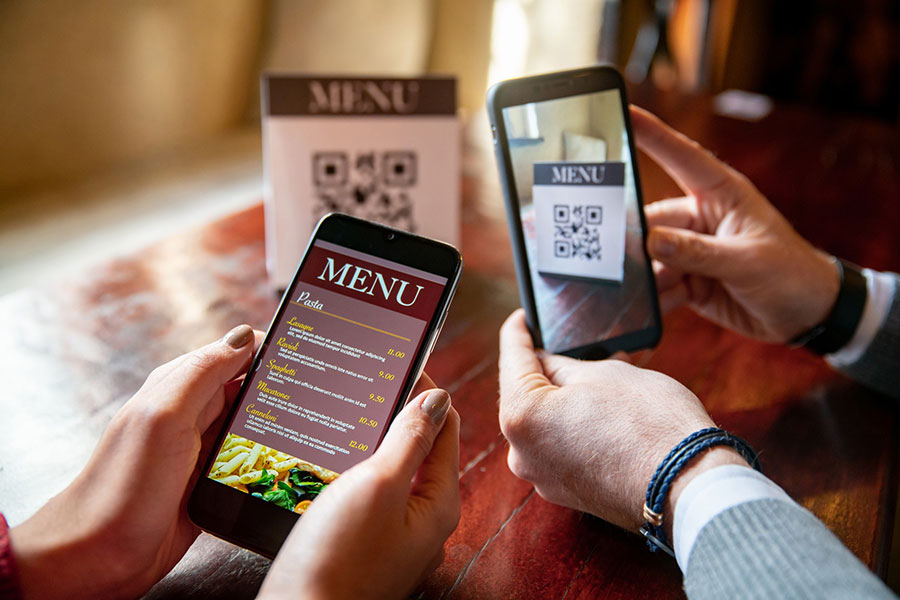
- Making QR (quick response) codes — those square barcodes that look a bit like abstract art — available on tabletop, at the storefront, and on marketing materials is the next rung up the digital menu ladder. They allow customers to quickly click through to the most current version of your digital menu as soon as they’re seated.
- Finally, QR codes can be integrated with contactless ordering and payment systems. A Restaurants Canada press release from December 2020 states: “QR codes are the new norm for menu viewing, touchless ordering, and paying the bill.”
A Deeper Dive into QR Codes
While QR codes have been around since the ’90s, they’ve really taken off as foodservice operators and consumers adapted to the realities of the COVID-19 pandemic. Using them is easier than ever, helping foster their ready acceptance by the dining public.
Many newer smartphones have built-in QR code viewers, so no special app is needed. A patron can simply open their phone’s photo app, focus on the QR code, and then follow the pop-up link to the restaurant’s menu. This makes ordering faster and minimizes contact with the server.
The right website platform can take QR codes to the next level with contactless ordering and payment system integration. Customers can order and even pay the bill from their phone to have their meal delivered to their table (or for takeout and delivery), for the ultimate in convenience and contactless dining.
“Guests can easily access the restaurant’s ordering menu via the QR code and order directly from the menu. This reduces short-term labour costs and increases table turnover with faster, more efficient ordering.”
Amina Gilani, Co-Founder and COO of Sociavore
QR codes also benefit restaurant operations, as Gilani explains: “Sociavore’s contactless dining feature streamlines the restaurant’s service by sending orders directly from the guest’s phone to the kitchen. Guests can easily access the restaurant’s ordering menu via the QR code and order directly from the menu. This reduces short-term labour costs and increases table turnover with faster, more efficient ordering.” She says, for instance, that this feature has powered the largest patios in Toronto (the Distillery District and RendezViews) as well as many independent restaurants.
Letting your community know about these safety enhancements may encourage the hesitant to return to in-person dining more quickly. It’s also helpful in retaining and attracting staff, a major industry concern.
Bye-bye Paper Menus?
The pandemic has certainly accelerated the demise of the formal printed menu. Many restaurants switched to single-use menus for safety reasons before moving to QR codes. But it may be premature to declare paper menus as passé as paper letters.
Not everyone has a smartphone. Some don’t have data and need your WiFi to use QR codes. Sometimes people simply forget their phone. Even the most tech-advanced restaurant should have some single-use paper menus available as a contingency.
Tips for the Digital Menu Age
- Embrace digital design — “Let your menu reflect your brand!” Gilani says. “Don’t be afraid to switch it up and create new menus for special events or holidays. Also, be sure to include a clear, well-lit photograph of each menu item — you’ll notice a significant increase in online sales and basket size.”
- Help customers become tech savvy — Some customers need to get comfortable with menu technology. Tactfully show them the ropes. Demonstrate that using QR codes is as easy as opening their phone app, and show them how to find more details about menu items. Once they’ve got the hang of how simple it is to use a tabletop QR code, they’ll be converts.
- Be generous with those QR codes — Consider placing several QR code stickers on each table. After all, patrons clamouring to click through to your digital menu won’t want to queue up for their chance!
Big non-meat, plant-based alternatives are here to stay – and growing.
A recent study by Technomic reports “almost two-thirds of Canadian consumers (65%) consider vegetarian offerings to be slightly or much more healthy. And, a quarter express they are ordering more healthy items at foodservice now than two years ago.”
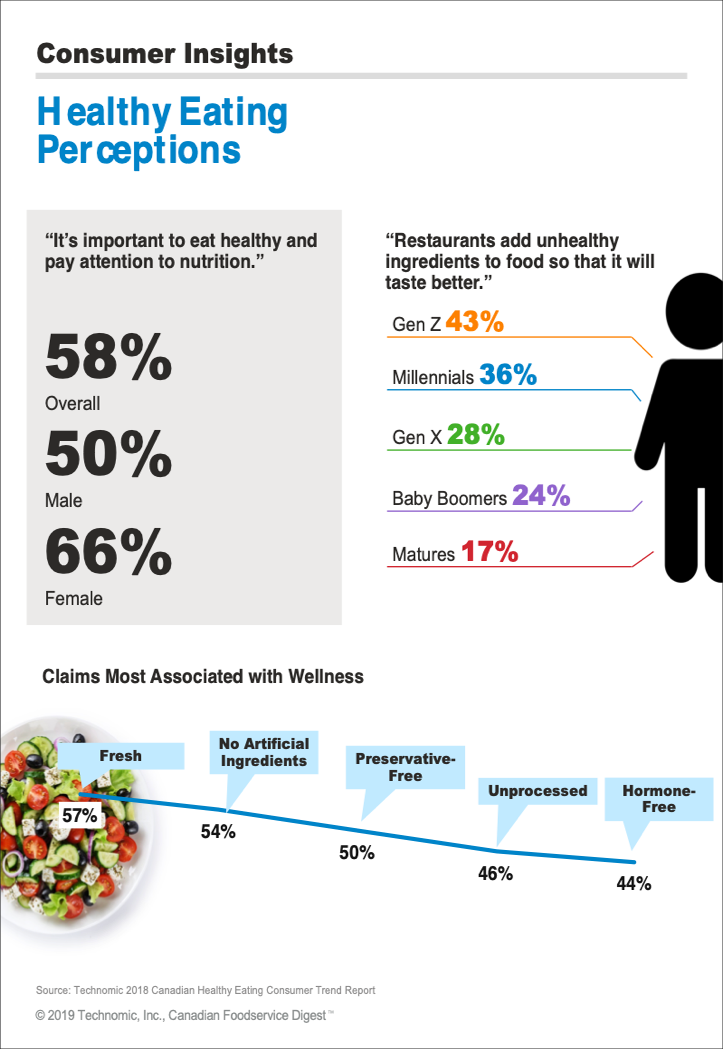
According to Technomic, “Gluten free is the top health claim across segments due to its popularity for both dietary and allergy reasons. Gluten-free claims also line up with many low carb diets like keto that are rising in popularity. Since these leading labels are on the top 200 restaurant menus, consumers may expect to see specialty options more widely available.”
Healthy Claims at Top 200 Limited-Service Restaurants
| Leading Claims | Fastest-Growing Claims | |
|---|---|---|
| 1 | Gluten-free | Vegan |
| 2 | Vegetarian | Dairy-free |
| 3 | Diet | Diet |
| 4 | Vegan | |
Healthy Claims at Top 200 Full-Service Restaurants
| Leading Claims | Fastest-Growing Claims | |
|---|---|---|
| 1 | Gluten-free | Vegan |
| 2 | Vegetarian | Diet |
| 3 | Diet | Dairy-free |
| 4 | Vegan | Keto |
As a result of this demand shift, restaurants are featuring plant-based proteins in a variety of applications. Optimism that the future is bright for plant-based protein has been fuelled by the reaction to the wave of products from Beyond Meat and others that have seemingly cracked the code and done the improbable – bridging the chasm between meat and meat-alternatives – by offering healthful and appetizing alternatives to beef and pork that replicate the taste and mouth feel consumers crave.
A&W introduced the Beyond Meat burger in Canada in 2018 and, thanks to unexpectedly high consumer trial, sold out beyond the ability of the supply chain to maintain inventory. A&W soon after introduced a Beyond Meat Breakfast Veggie-sausage sandwich that shocked consumers by the degree to which the product tasted like “real” sausage.

Large protein players like Tyson Foods and Maple Leaf are betting many millions that this trend has even longer legs. Maple Leaf announced plans in 2019 to build a US$300 million 230,000-sq.-ft. processing plant in Shelbyville, Indiana to more than double Maple Leaf’s investment in meat alternative offerings like its Lightlife Burger. Michael McCain has called plant-based protein “a billion dollar opportunity,” and recently told analysts that “it is on the cusp of becoming mainstream.”
In an interview with the Toronto Star, he said “in our plant-based business, we are confident that there’s a significant growth opportunity. Right now, most of our activity is around organic growth. We’re investing in new plant capacity, new innovation.”
Kids and plant-based restaurant menu alternatives
Even kids’ menus, traditionally boasting options like breaded chicken fingers and mac ‘n cheese, are going healthier.
According to a recent Technomic insights report: Over the past year, traditional kids menu offerings have declined, including kids grilled cheese (-16.5%), kids hamburger (-22.2%) and kids french fries (-36.4%), while lighter categories, such as kids salad, have seen an increase (+29.4%). “This demonstrates the swap of some heavier dishes for healthier choices that millennial parents most especially have been gravitating toward for their children.”
Fastest growing ingredients on kids’ menus
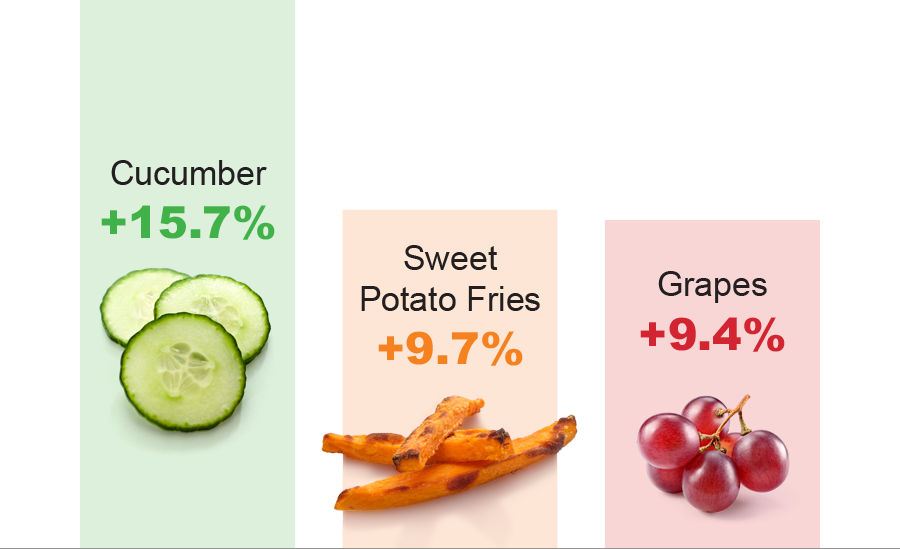
Savvy operators are taking note and adjusting their kids’ offerings to make them healthier and more mature.
Where do you play in the “healthy” sandbox?
A host of operators – including heavyweights like McDonald’s and Tim Hortons – emerging in all segments of foodservice have, in full or part, revamped their offerings to appeal to the broad constituency of health-seeking consumers (Exhibit 2). Sift your menu through this growing group to see how much ground you cover in the “healthy” sandbox.
One company, Montreal-based Copper Branch, billed as the largest vegan restaurant chain in the world, has ridden the plant-based wave to more than 30 locations including in the US.
Copper Branch has gone beyond vegetarian/vegan, and embraced the key elements of what “healthy” means to today’s consumer – fresh, natural (non-GMO, nothing added), free-from, unprocessed, sustainable, low carbs, nutraceutical, and more. Their menu items tick a lot of consumer boxes, from raw and organic naturally fermented Kombucha beverages, to sandwiches served on a choice of organic ancient grain kamut bun, gluten-free bun, collard green wrap or organic spelt wrap… and they let their customers know through bold menu design and social media.
Does your restaurant menu measure up?
It’s clear, if your menu is not speaking the language of current consumer health and wellness perceptions, you’re losing ground.
So, how do you make sure this key sales tool of your restaurant operation reflects your values if you want to communicate a shift to healthier options? The solutions are easier – and less expensive – than you might think:
- Speak the language. Copper Branch uses terms like “100% plant-based, gluten-free options, all-natural, many organic & non-GMO ingredients.” If you choose to make these claims, though, be prepared to back them up with what emerges from the kitchen.
- Use symbols in the form of a menu legend and place them next to menu items, much the way soome restaurants let diners know if dishes are mild, spicy or super-hot. WebstaurantStore blog recommends a menu legend like this one:
- Grill – A grill shows that chicken, sandwiches, patties, fish, and other foods can be grilled rather than sauteed, deep fried, or cooked in butter.
- Leaf – A leaf shows that pasta dishes, sandwiches, wraps, salads, and other foods can be made vegetarian.
- V – A “V” shows that vegetarian dishes can be made vegan.
- Grain – A grain shows that sandwiches, subs, and wraps can be made with whole grains instead of white flour.
- Zigzag – A zigzag symbol inside of an oven shows that crab cakes, seafood, meats, and poultry can be broiled rather than deep fried or sauteed in butter.
- Vegetable – A vegetable shows that certain meals can be made with organic ingredients.
- Sugar-Free – A sugar-free symbol shows that desserts or drinks can be made without real sugar.

- Offer sensible substitutions – and let your guests know. Use your menu to communicate that you can create healthier alternatives, such as grilled instead of breaded and fried, if diners reqest them.
- Try “healthy” promotions like a special “Meatless Monday” menu.
- Use social media to spread the word that you’re a “healthy” place to be.
Crispy Haddock Sandwiches
Serve up a comforting pub classic, with your own twist. This recipe kicks up the heat on your traditional tartar sauce, and added some sweetness with an apple slaw.
- Yield: 6 1x
Ingredients
- 6 High Liner Beer Battered Haddock Fillets
- 6 ciabatta buns, toasted
- jalapenos, sliced
- tomatoes, sliced
Jalapeno Tartar Sauce
- 237 ml mayonnaise
- 1 jalapeno, seeded and finely diced
- 30 ml sans marcus verte sauce
- 15 ml sweet relish
Apple and Kale Slaw
- 710 ml apples, julienned
- 473 ml heirloom carrots, julienned
- 237 ml green kale, julienned
- 237 ml purple kale
- 118 ml poppy seed dressing
Instructions
- Cook fish according to package directions.
- Make your slaw. Combine apples, carrots and kale. Add poppy seed dressing and mix well to coat.
- Make the tartar sauce. Combine all ingredients and mix well.
- Build your sandwiches. Spread tartar sauce on open bun. Add cooked haddock, and top with slaw, tomatoes and jalapenos. Serve with lime wedges.
Notes

<!-- wp:wp-tasty/tasty-recipe {"id":12143,"lastUpdated":1635979626498} /-->Big Bob’s® Haddock Surf Board
Charcuterie boards are popping up on menus everywhere. These boards normally offer a selection of cured meats and cheese. In order to create a seafood option, this recipe deconstructs traditional fish and chips into a big, bold, fun and sharable board that High Liner likes to call a ‘Surf Board’.
Ingredients
- 1 pc Big Bob’s® Beer Battered Natural Cut Haddock, #10025643
- 4 oz cactus cut potato wedges
- 4 oz sweet potato fries
- 4 oz prepared coleslaw
- 2 oz tartar sauce
- 2 oz curry mayo
- 2 oz ancho sour cream
- 1 lemon halved and grilled for garnish
Instructions
- Assemble the dipping sauces in small ramekins and pre-grill the lemon garnish.
- Add the coleslaw to a small dish.
- Deep fry the Big Bob’s® Haddock for approximately 6 mins then slice it into 8 or 9 strips across the width of the fillet.
- Deep fry the 2 varieties of potatoes.
- For assembly, be creative and look to gain height where possible and also think about balancing the colours.
Notes