
Rising inflation, currently affecting food and many other goods, is challenging restaurateurs and consumers alike. And food inflation is just one of the factors that can lead to menu inflation in restaurants.
The challenge for restaurant operators is to create a menu that’s cost-effective for both themselves and consumers, so they can operate with the best possible margins while still encouraging business in this time of renewed restrictions and rising costs.
Understanding the restaurant inflation crunch
Canada’s Food Price Report 2022, an annual collaboration of Dalhousie University and the Universities of Guelph, Saskatchewan, and British Columbia, “forecasts an overall food price increase of 5% to 7% for the coming year, the highest predicted increase in food prices since the inception of the report 12 years ago.”
Given the current rate of food inflation, it’s not surprising that menu inflation is occurring in restaurants. Restaurants Canada’s Restaurant Outlook Survey Q3 2021 reports that “nearly six in 10 respondents are expecting to raise their menu prices by 4% or more, with 23% expected to raise menu prices by more than 7%,” (the highest level above 7% since the survey began in 2011).
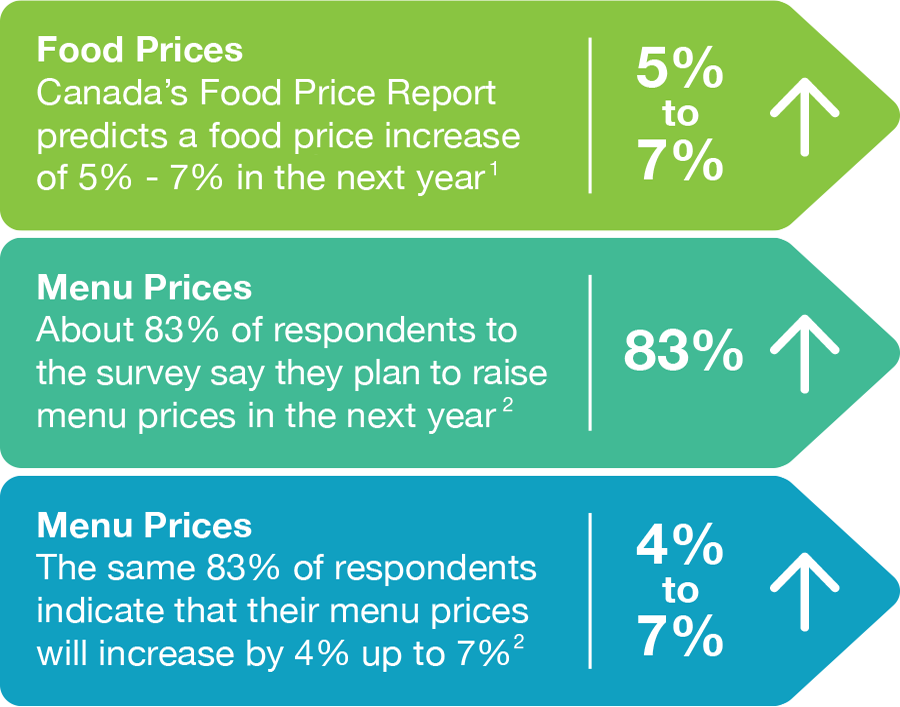

1. Source: Canada’s Food Price Report 2022
2 Source: Restaurants Canada’s Restaurant Outlook Survey Q3 2021
Food prices aren’t the only pressure contributing to menu inflation. Others include supply chain issues, labour shortages, pandemic-related dining-in restrictions, the costs of PPE and other safety measures, and the need to implement vaccine passports in some jurisdictions. Restaurants Canada reports that many of their survey respondents intend to partially absorb operating cost increases, rather than fully pass them downstream to customers via menu price increases.
Restaurant menus need to be as cost-effective as possible for the benefit of both operators and their price-conscious customers who may be responding to inflation by tightening their discretionary spending belts.
Here are 7 tips to increase restaurant profits
A combination of complementary strategies to address increasing food and operating costs can help you provide more cost-effective menus. And doing what you can to help those in need just may encourage your community to keep supporting your establishment through these difficult times.
Downsize Menus
Shorter menus are here to stay. They’re a good way to mitigate supply issues and higher costs, while managing a return yet again to takeout and delivery only in some provinces. Pared-down menus also help you streamline staffing, manage inventory more effectively, and reduce waste. They also make it easier for restaurant operators to benefit from dishes where high sales and maximum profit intersect.
Streamline Operations
With today’s labour supply challenges now further complicated by the higher absenteeism rates caused by the Omicron variant, restaurant operators must keep effective retention and recruitment top of mind. Optimizing scheduling, maintaining good employee relations, and showing appreciation for staff who step up to fill gaps in the schedule can help you avoid the costs of reduced capacity or closures due to absenteeism. Menu streamlining can help you reduce your base staffing complement – important in a time of labour shortages.
Manage the Supply Chain
Now more than ever, it’s important to have good lines of communication with your suppliers. Work with them to keep on top of product availability and price fluctuations so you can plan your menu accordingly. Also talk to them about any special offers you can benefit from.
Get Creative with Proteins
Proteins are usually the centrepiece of a dish. And animal proteins are generally the costliest ingredient. With some creativity, you can move beyond the extravagant steaks and typical chicken breasts to offer proteins in more affordable ways. In addition to smaller portions of meat and poultry, explore using cheaper cuts, which are often more flavourful and offer the chef more creative scope. Think chicken thighs in a hearty sauce instead of grilled breasts. More economical plant-based proteins, like chickpeas and lentils, either in wholly vegetarian or vegan dishes, or in combination with smaller portions of animal proteins, are another approach to a more cost-effective menu. For more ideas, see the article What’s the True Cost of Proteins for Foodservice Operators?
Reduce Waste and Pay It Forward
Wasted food and wasted supplies is wasted money, and who can afford that? A smaller menu leads to a tighter, more manageable inventory, helping you use items before their expiry dates. Designing your menu so ingredients can be used in multiple dishes is another waste reduction strategy.
Support community members who are suffering the effects of food inflation by donating food you can’t use in time to local food banks, shelters, and other programs.
Harness Technology for Agility
One word we’ve all heard over and over during the pandemic is pivot. With menus switching up frequently due to ongoing supply chain issues and price fluctuations, digital menus allow for easy revision. Having a website built on the Sociavore platform, for instance, provides you an online ordering system that frees up staff for other tasks. It also helps you avoid steep third-party fees by using local delivery networks or the DoorDash integration for order fulfillment.
And like many things today, when it comes to food waste there’s an app (or many) for that. For example, Too Good to Go has launched in Toronto, Vancouver, and Montreal, and allows restaurants, bakeries, grocers, et cetera to sell leftover food and prepared dishes at a discount through the app. Not only does this reduce waste and help you recoup a portion of your costs, but it helps build good community relations.
Utilize Government Support Programs
Inform yourself about the government support programs your business qualifies for and identify which meet your needs. Taking advantage of economic support can bolster your efforts to keep menu inflation at a level that still encourages your community to dine in or order out.
Looking for a fun way to woo guests back inside for winter dining? How about adding some game time to your menu? Increasingly, guests are bringing their “game face” to restaurants where they are expecting entertainment that goes beyond food and drink.
Kids’ games – such as paper placemats and crayons for colouring – have been around for years as a way to entertain the younger generation and keep them occupied while waiting for their meals. But what about the adults? How do you keep them engaged, ordering, and off their smartphones?
Many family restaurants, bars and sports-themed eateries already include active play on their menu, like such popular options as dart boards, billiards tables, trivia games, foosball tables, and more.
Games keep your guests engaged and may encourage them to linger longer – with more opportunities to upsell and increase check size. They also brand your restaurant as a fun venue and the place to be, plus games can help build a bond between staff and guests.

Raise your table stakes
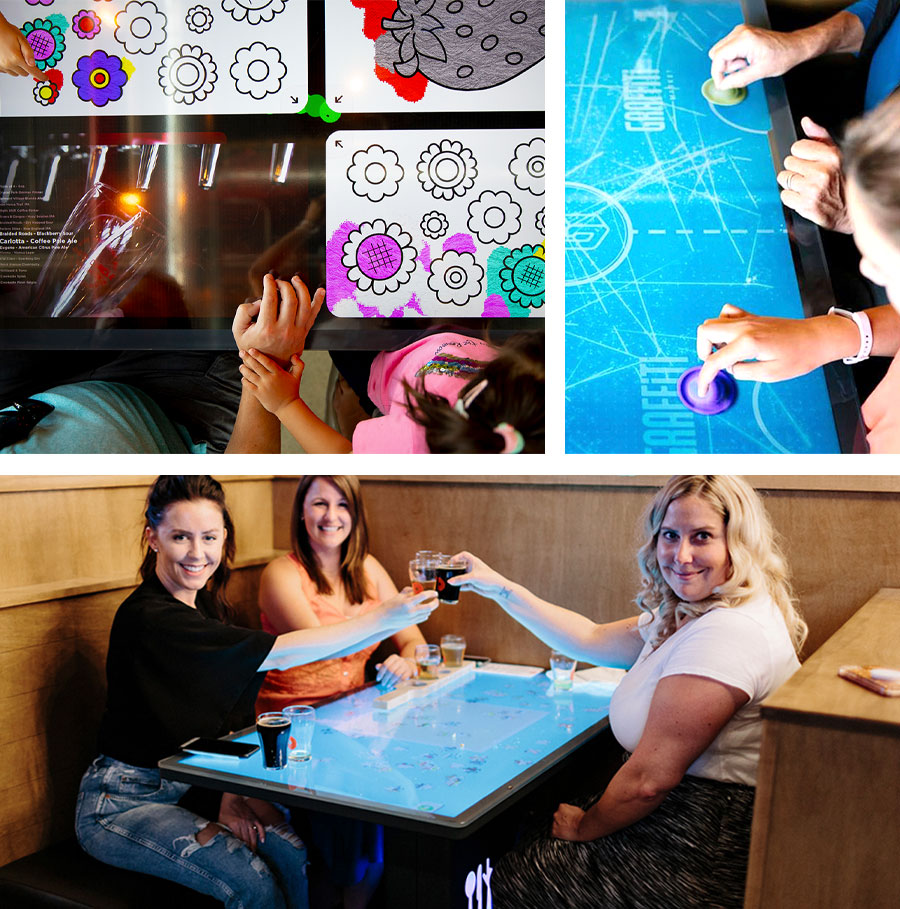
One restaurant offers a gaming option with a twist. Graffiti Market in Kitchener, Ont., a combination restaurant, microbrewery, market, coffee roaster and bakery, features highly interactive game play right at diners’ tables.
Ryan Lloyd-Craig, co-owner of the Ignite Restaurant Group, of which Graffiti Market is a part, wasn’t even thinking of games when he saw his first interactive smart table. “The idea didn’t come to me overnight. I was walking the technology section of the Restaurants Canada show and came across a gentleman standing on what looked like a giant iPad until I got closer and found that it was an interactive table made by Kodisoft (a tech company based in Ukraine).”
Lloyd-Craig’s original thought was not even about games but mainly about using the tables as a way for guests to order interactively, have food runners bring the items to the tables, and then have the tables function as a complete POS system. Other countries were already using the Kodisoft system successfully, but no one in Canada had tapped into combining business with pleasure right at the table.
The games people play
Lloyd-Craig’s interest in the tables quickly evolved into something different from an ordering and POS solution. “The benefit of these tables is that you can visually see every item on the menu so it makes it easier to order, but their main appeal is keeping people engaged and entertaining them while waiting for their food. People are putting down their cellphones and actually talking to each other. That’s kind of neat.”
The tables offer a variety of gaming options. He started with a simple colouring application, then a doodling app after the first month, before adding puzzles for all age groups (from a basic jigsaw puzzle for kids), air hockey, Chinese checkers, and most recently, chess, all of which can be turned on or off depending on how busy the restaurant is.

The tables can also support advertising, both internal and external (for instance from sports businesses running commercials and interacting with guests), though so far Lloyd-Craig hasn’t tapped that potential.
Interestingly, far from encouraging guests to linger, guests using these interactive restaurant tables want to clear the menus and food off faster to get back to their games. Lloyd-Craig’s initial goal, in fact, was not to get diners to stay longer, but to realize labour savings from integrating ordering with serving and paying for a total POS solution – “any way you can save two or three per cent off the bottom line,” as he puts it. The restaurant hasn’t been open long enough for him to see these savings yet, but he has experienced a steady increase in sales since he brought in the game tables – and that means he’s already ahead of the game.
Not all games have to cost the earth for you to add. Take trivia. This option’s been around since Trivial Pursuit took off decades ago and has become a bar and casual restaurant staple. Trivia is a particular hit with Millennials looking for interactive experiences and can liven up slower winter months in any family-style restaurant. Companies like QuizRunners and Quizzholics design, create and can run your trivia games professionally. Who knows? Your eatery could become a stop on a trivia circuit.
Tabletop inspiration
- Visual menus encourage ordering, and ordering more – especially highly visual desserts.
- Restaurants can market and advertise their promotions and potentially attract outside advertisers.
- Table games encourage guests to put down their smartphones and focus on the dining experience.
Top tips to add games in your restaurant
- Develop a games budget. You can start with something as simple as setting up game nights and bringing in board games from home. But the sky’s the limit on what you could spend to add a games component. Each of Ryan Lloyd-Craig’s 23 smart tables (Graffiti also has 25 “dumb” tables) costs $15,000 US, not including maintenance.
- Create a brand theme and strategy. What will set you apart? A sports bar, for instance, might naturally gravitate to sports-themed games, while a family-friendly eatery would pair well with trivia nights.
- Know your demographics. Kid-friendly restaurants are perfect venues for everything from fun “play” menus to dedicated kids’ games areas, while adult-oriented restaurants might be better venues for trivia nights, darts, even bingo.
- Be clear on your goals. Are games a way to encourage your guests to linger longer, an opportunity to entertain young diners, a chance to bring in business during slow periods, a way to attract new guests, or an opportunity for guests to put their devices down and enjoy some family time?
- Check your real estate. If you decide to bring in game tables, dart boards, foosball tables, do you have the space for these plus your dining tables? Don’t bring in games at the expense of your regular eating areas. After all, it’s still mainly about the food!
As a hospitality brand, your business is built on the premise of serving customers’ needs with an experience and value aligning with their expectations. The question is, have you done the due diligence to truly identify and understand who your customer is?
The answer to this is critical to the success of effectively attracting the right customers who reflect your brand experience, to achieve a win-win customer-centric approach.
But why leave it to guesswork? It’s time to eliminate the stabs in the dark. Here are five easy strategies to identify who your guests are through relevant information and factual insights.
Customer-centric: you know who your customer is and your restaurant experience is designed foremost to service their needs and meet their expectations.

Location, Location, Location
It may be an old adage, but your restaurant location plays a significant role in identifying your largest potential customer base. Location acts as a convenience factor, meaning guests who reside or work nearby are more likely to frequent your restaurant, and more regularly as well. If your eatery is near a family suburban community, then you will likely be attracting more families with children, versus a downtown city restaurant. Your city or municipality can provide you with the demographic information of who resides in your area. The first step is to utilize these data to define your overall brand experience to match with the people most likely to dine with you, and the type of guests you want to attract to meet your objectives. Use this to guide the brand theme, service level, ambience, décor, menu offering, and price point.
Who’s eating there
Understanding who your closest competitors are and the types of guests they’re attracting is typically a realistic representation of those you can expect to serve as well. So, get out there and visit at least three competitors within the same restaurant category as you: quick service if you’re in the quick service sector and family casual if you’re catering to that market. Create a list of attributes you’ll be comparing such as operational flow, marketing, team uniforms, atmosphere, menu offering and price. Then take a seat at their table to truly understand the service experience and the types of guests also dining in or taking out. Be sure to note your observations on your checklist for easy comparison and analysis to help identify who your customer will be, or should be.
- TIP: Read your competitors’ customer reviews and browse their social media platforms to better understand the community of guests they are attracting and serving!

The digital customer is your customer
Some of the most useful information to understand your customer is right at your fingertips, literally! Social media platforms provide factual data on who is engaging with your brand from their location, age, gender, and the type of content they are most engaged in. The best part? All of this information is FREE and can be viewed over various time frames to observe how your digital customer community is growing and changing based on your marketing efforts. Start by creating a monthly report in Excel, so you can track user demographic and engagement results. Analyzing this info may uncover gaps between who is engaging with your digital brand versus who is actually dining with you, and where to focus your efforts to attract the right customer for better business results.
Have you asked them?
Ask and you shall receive, as the saying goes. If you’re an established restaurant with a social media community or a customer email list, an efficient low-cost strategy to better understand your actual customer is to ask them more about who they are. Go to the source for up-to-date intel, by creating surveys of one-10 questions or social media polls to collect data about their location, age, lifestyle, preferences, and ways you’re performing from their perspective. Remember to keep the questions short and sweet to improve customer response results. This info will be invaluable not only to identify who your current customer is, but also to improve operations and service levels to better align with guests’ expectations. Utilizing incentives such as gift cards or complimentary menu items is an effective way to motivate responses, while making guests feel valued by your brand. Total win-win!

Get to know them, personally
An approach at the core of the most successful hospitality brands is taking the time to truly get to know your guests on a personal level. Everybody wants to feel welcomed and valued, so that when diners walk into their favourite restaurant, they feel special when greeted personally by a familiar face. The simplest and likely the most rewarding approach to understanding your customer base is to have your team take the few extra minutes per visit to ask guests questions that in turn create the customer-centric experience. (Be careful, though, to be subtle and not intrusive.) Turn this service approach into a strategy by having a set of questions each service team member is to utilize to spark conversation with each new table. Once they’ve received the guest responses, have them document the guest profile in a shared document. The result? Collectively, as a team, you are gathering relevant information to better understand your current customers, how to better serve them, and how to improve business success.
Key demographic data to try to collect:
| Gender |
| Ethnicity |
| Age range |
| # of guests dining |
| With or without children |
Here are a few question examples:
- Name introductions.
- Inquire if they live in the neighborhood. If they do, great; if they don’t, ask casually where they’re from.
Now you will gain an understanding of how far guests are willing to travel to experience your brand. - Have they dined with you before? If so, what did they order the last time? Did they enjoy it?
- TIP: Great opportunity for suggested upselling here!
- Find out how they first heard about your restaurant.
This will provide insight on the effectiveness of your marketing and communication strategies.
In addition to these consumer data collection strategies, most point-of-sale systems provide valuable customer lifestyle and preference data such as most popular dining times, preferred menu items, and average cheque size. Report on these findings monthly and summarize the results along with the demographic data collected. By combining these five strategies and analyzing the valuable information over an extended period of time, you will achieve a clearly defined customer base you can better serve with a more finely tuned customer-centric approach.
Every week, websites across the country like DineSafe present a list of foodservice establishments that have been closed, or issued conditional warnings of closure, and the violations that have been cited.
Inspection results identify restaurants, cocktail bars/beverage rooms, bakeries and QSRs deemed by Health Inspectors to be in violation of the provincial food safety regulations.
Violators can run the gamut from independent bakeries, food court operators, and franchise restaurants, to independent family restaurants. The element that violators have in common is a breakdown in the processes and procedures that ensure food safety.
In a world of open social networks, there’s nowhere to hide from the downside risks of violating health codes and/or consumers being affected by foodborne illness. During the pandemic, concerns about food safety have only been magnified. Thus, interest in and attention to safety needs to permeate the business culture of absolutely all operators, no matter their size or location, working with food.
The 5 top restaurant food safety areas of concern
The vast majority of food safety violations fall into the following problem categories commonly identified in foodservice inspections. Roughly 80% of the food handling practices leading to foodborne illnesses are covered by five specific breakdowns:
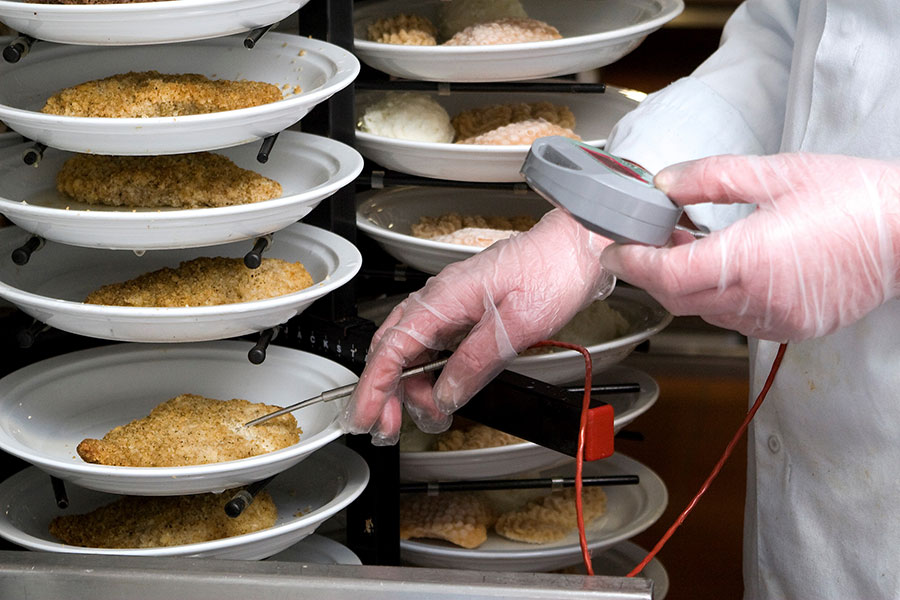
- Keeping hot/cold food at correct temperatures
- Proper handwashing practices
- Food contact surfaces protected from contamination
- Sanitation plan and cleaning schedule
- Dishwasher procedures
Root causes
Pam Mandarino, an environmental health officer in Vancouver, conducted an extensive food safety study (2017) which analyzed inspection report data on temporary restaurant closures and food handling violations in British Columbia. The study cross-referenced findings of similar studies conducted in the U.S.
Mandarino concluded that multiple factors, and not just food safety knowledge, affect safe food handling practices.
Below are some of the factors she found that influence safe restaurant food preparation practices:
- Time pressures
- Manager indifference toward proper food safety practices
- Food safety certification and food safety training
- Inadequate food handler knowledge
- Poorly designed kitchen facilities and insufficient standard operating procedures
Stop food safety problems before they begin
Proactive attention to food safety practices and processes is your best bet to circumvent a food safety crisis. That being said, having an action plan in place to address a crisis, isolate the causes, and map a recovery path can forestall devastating outcomes.
Myths and Truths About Food Poisoning
| Not True | True |
|---|---|
| A food with enough pathogens to make you sick will look, smell or taste bad. | A food with enough pathogens to make you sick may look, smell or taste good. |
| Really fresh food cannot make people sick. | Really fresh food can cause food poisoning if it is not properly handled. |
| Only dirty kitchens can make people sick. | Even clean kitchens can make people sick. |
| Properly cooked food can never cause food poisoning. | Food poisoning can occur even when foods are properly cooked. |
Source: BC Centre for Disease Control (2009), Ensuring Food Safety Writing Your Own Food Safety Plan – A Guide for Food Service Operators.
Gathering storm
In 2019, the Canadian Food Inspection Agency introduced the Safe Food for Canadians Regulations (SFCR). The SFCR legislation requires food suppliers, importers/exporters, and foodservice operators to mandate preventability and to improve traceability – not an insignificant ask, given that the majority of the food we consume in Canada comes from abroad.
Lawrence Goodridge, Director at Canadian Research Institute for Food Safety, University of Guelph, feels that SFCR does not go far enough. He compares the traditional “surveillance” approach to food safety to predicting the weather: Each of us checks the weather each day, yet no individual feels strongly that their specific observations can accurately predict what will happen.
Smartphone apps are being engaged to accumulate user weather observations and their geo-locations. Feeding this data into artificial intelligence algorithms can create more accurate meta-reports on local weather patterns in real time.
Imagine now that food safety was tracked in a similarly proactive fashion. Responses on foodborne outbreaks could be identified very early on, via smartphone, by individual consumers, leading to faster removal of contaminated food from the food chain.

Top tips to prevent food safety situations
Restaurant food handling tip sheet
- Label and date your products when you receive them or when you prepare them.
- Understand proper food storage temperatures and storage.
- Rotate your food products (first in, first out). This should be standard procedure for everything: canned goods, produce, meat, dairy.
- Constantly do checks of the food in your fridges and ensure they’re set at the proper temperature.
- Reheat foods properly.
- Ensure correct handling of fresh produce, for instance not leaving it standing in cold water.

Restaurant food handling training
- Consider hiring a licensed cook with responsibility for ongoing staff training.
- Make sure all staff take a food handling course.
- Make equipment handling courses mandatory, including an annual refresher so staff understand correct operation and cleaning of all equipment.
- Work the relationship with your local health unit and ask if they’ll help with training.
- Rehearse your food handling procedures. Don’t wait for a crisis to happen, be prepared to respond.
Restaurant cleaning
- Maintain a cleaning checklist, posted prominently for kitchen staff.
- Ensure your equipment is cleaned and sanitized.
- Work with your cleaning equipment supplier to recommend best products to use in the kitchen. A lot of suppliers will come in and train your staff.
Educating
- Stay on top of food safety issues. The CFIA publishes regular updates on food-borne issues along with the latest acts and regulations. Food manufacturers publish regular bulletins on their products, and many distributors also send out food safety alerts.
- Sign up for the National Food Safety Training Program, offered across the country.
Breakfast for dinner? We can thank social media for popularizing this trend. A Twitter storm a few years ago helped McDonald’s Canada to decide that breakfast-for-dinner was here to stay.
And who were those tweeting customers? The Millennials, of course. Younger millennials in particular – also known as ‘trailing millennials’ – are changing the game in foodservice. An extensive ongoing tracking study by Ipsos Canada of eating habits of Canadians reveals that Millennials tend to eat “small meals through the day when it suits their needs.” Millennials seek food options that reflect their non-conventional lifestyle. According to the Ipsos study lead, “(Millennials) do things on their own time. They’ve never known ‘closed on Sundays,’ they shop when they want, they work – many of them – in situations that appease their need to have their own schedules.”
“(Millennials) do things on their own time. They’ve never known ‘closed on Sundays,’ they shop when they want, they work – many of them – in situations that appease their need to have their own schedules.”
Ipsos Canada
Foodservice operators – and not just the giants like McDonald’s – are taking notice and adapting to meet this expectation.
In Canada and the U.S., the Millennial Generation Y cohort is now as large as the Boomers, according to Statistics Canada. As a percentage of the labour force, GenY is already far and away the biggest group. These numbers speak volumes, and underscore the inevitability of demography in a “post-growth” 21st century.
In her book, “A Taste of Generation Yum: How the Millennial Generation’s Love for Organic Fare, Celebrity Chefs, and Microbrews Will Make or Break the Future of Food,” Eve Turow-Paul, herself a Millennial, spent close to four years interviewing peers, reviewing academic work, and talking to iconic foodies like the late Anthony Bourdain and Michael Pollan.

The genesis for the book was an observation she made while sitting in a college class. “One of the girls across from me was saying that there was a frozen yogurt place (that had) flavours that changed every day. She had the number on her phone and would call them every day to see what the flavour (du jour) was.”
This observation was the catalyst for her research. Her chief takeaways?
What?
Millennials are the most food-obsessed generation in history.
Newton’s 3rd Law states that for every action, there’s an equal and opposite reaction. After all of that screen time on their smartphones and other devices, it’s not surprising that Millennials are looking for something tangible, genuine, and sensory.
Why?
Generation Y is the product of the shock of colliding negative and positive factors.
The negative charges: political cynicism and sustained economic recession. On the positive side: ever expanding access to technology and information. The result is mixed and somewhat contradictory. Many studies have concluded that Millennials exhibit elevated rates of anxiety, depression, and even suicide. However, access to technology and social media provides Millennials with the sense of empowerment, community, and control they crave.
Now What?
Turow-Paul pulls no punches: “I think we need to make food something that Millennials want to be part of their brand. We need to make it hip. I don’t believe that this is a generation of people who just want to do good things; I think (Millennials) are self-serving and narcissistic. I think we’re really invested in branding ourselves.”
For Millennials, what and where they eat (or don’t eat) is as much a part of their identity as the social media sites they connect on. The labels Local, Organic, Gluten-free, GMO, Single-source, Bio-dynamic, Vegan, Cage-free, Paleo, Fair trade – have become powerful tags for this group.
Wondering how can your restaurant better engage with the Millennial tribe? There is no silver bullet. According to Environics Analytics, the group is extremely diverse. Beyond the “Living at Home” and “Left Home” divide, there are upwards of a dozen unique cultural, ethnic, educational, value, and economic archetypes among Millennials.
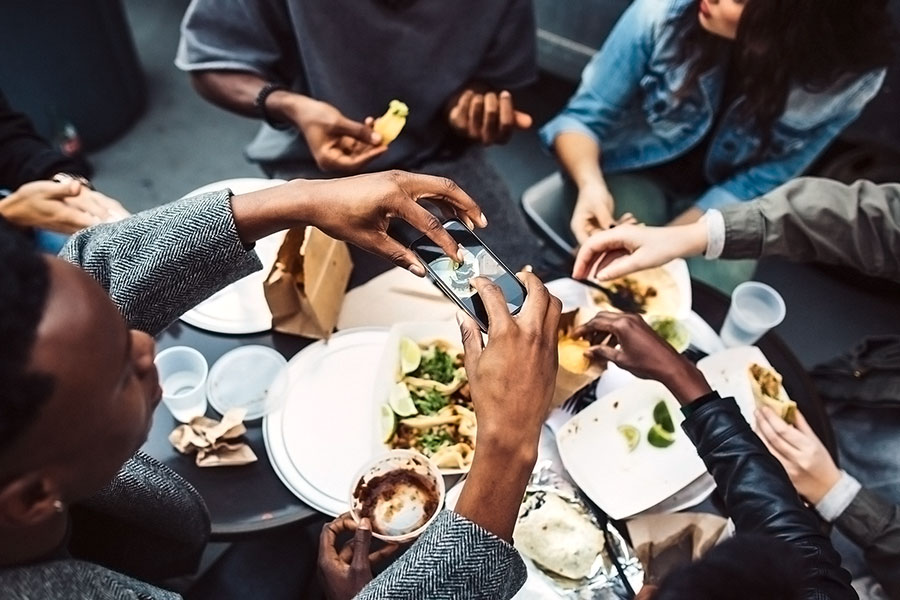
Millennials love their tech
The one commonality is technology. Smartphone ownership for Millennials is over 90% and significantly higher than for older Canadians. That’s why it is critical for restaurants to create an online presence where customers can easily find their menu.
All-in-one platform Sociavore helps independent foodservice operators manage their restaurant business online – from professional web presence to ordering, customer feedback, payments and analytics – so they can reach this tech-savvy cohort.
Top tips for foodservice operators to engage Millennials
- Make your brand their brand. Millennials are focused on personal brand-building. Try to make a connection between your offering and their personality.
- Work your social media channels. The Millennials are likely the most social media– and tech-obsessed generation.
- Consider your social conscience. Millennials are cause-focused, and they care about where their food comes from.
- Make it memorable. Millennials are looking for “experiential” eating. Touch, taste, appearance help to sell food to them.