

Is it all doom and gloom? According to projections by the Canadian Chamber of Commerce (based on Statistics Canada research), 60% of operators are at risk of closure by the end of 2020. Dark clouds continue to gather on the horizon: the prospect of a reduction in various government support programs; a six-month hiatus in patio dining over the fall and winter; and a likely second wave of the virus.
To better understand the mood and attitudes of Canadian consumers with respect to COVID-19, the Agri-Food Analytics Lab at Dalhousie sponsored a detailed research project conducted by Angus Reid in June 2020.
A total of 1,505 Canadians were surveyed. They were asked if they had been ordering food from restaurants during the pandemic and if they intended to return to their old habits afterwards. The survey also measured consumer expectations in terms of using foodservice in the rest of the year.
Behavioural impacts of COVID-19 — key insights
The good news
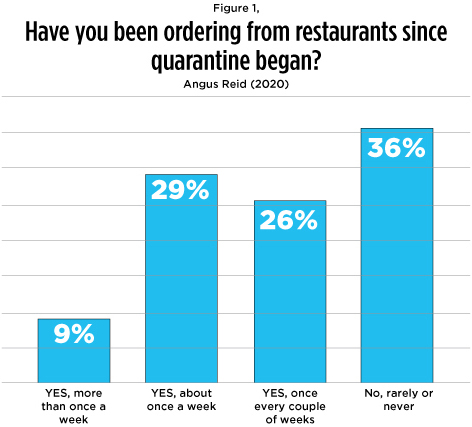
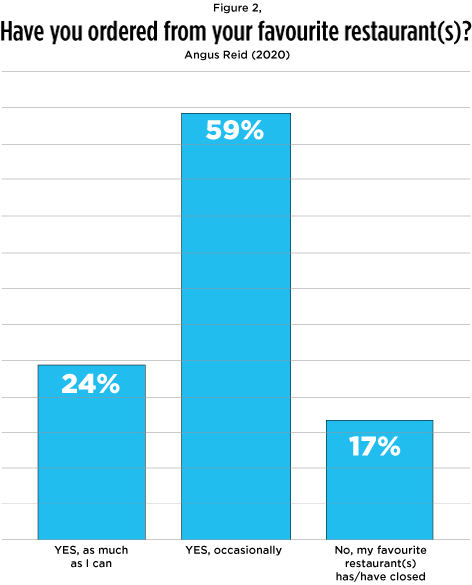
- Two-thirds of Canadians kept ordering food regularly from restaurants during the pandemic. A total of 64% of Canadians had ordered food at least every two weeks from a restaurant.
- A total of 83% of Canadians ordered from their favourite restaurant during the first three months of the pandemic.
- Younger people were more likely to order out from a restaurant. A total of 81% of respondents between the ages of 18 and 34 years old had ordered from restaurants, the highest rate among age groups.
- About 29% of Canadians ordered from restaurants at least once a week, and 9% had ordered food once a week since the beginning of the pandemic.
The bad news
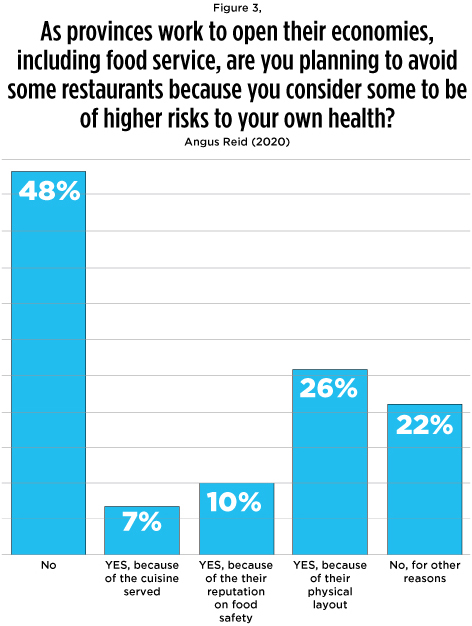
About half of Canadians were hesitant to resume restaurant patronage to protect their own health.
- Physical layout appears to be the most important issue for people.
- About 10% of Canadians say they will avoid establishments due to their food safety reputation.
- And about one-fifth of Canadians will avoid establishments for an undisclosed reason.
Bottom line for operators is the need to invest in changes to your physical environment and perceived service level to build trust. Consistency and commitment in the implementation of these changes will enable you to gain and keep consumer confidence.
Meeting and managing expectations
In the Dal Agri-Lab survey Canadians were asked what they expect to see when they return to their restaurant of choice. The overwhelming majority of respondents said they expected to see more personal protective equipment worn by staff, and measures taken to separate/protect diners (e.g. more plexiglass).
Interestingly, there was also an appreciation for the challenges faced by operators to maintain safety and manage the circumstances. Nearly 40% of Canadians said they expected slower service and 29% expect menu changes or fewer choices.
Author of the Dal Agri-Lab study, Professor in Food Distribution and Policy at Dalhousie University Sylvain Charlebois estimates that up to 30% of lost restaurant revenue in 2021 could be a result of people working from home. “The more people work from home, the less likely they are to spend money on food and beverages at local restaurants.”
“The more people work from home, the less likely they are to spend money on food and beverages at local restaurants.”
Sylvain Charlebois, Professor in Food Distribution and Policy at Dalhousie University
The road forward will depend on both governments and operators helping themselves by doing what is needed to optimize the safety of foodservice in order to convince guests that it is safe to return to restaurants.
Foodservice has already been buffeted by unparalled difficulties as a result of COVID-19. A survey of operators by Restaurants Canada at the end of March 2020 revealed that one in 10 restaurants in Canada had already closed permanently — roughly 10,000 businesses that had decided not to reopen. Charlebois adds, “We are expecting the industry to lose $20 billion, on top of what actually happened this spring. In a year from now, 25% of all restaurants will disappear.”
Though many more operators may be forced to close by 2021, the industry will endure. However, reduced meal occasions and altered consumer behaviour may be with us for the long haul.