
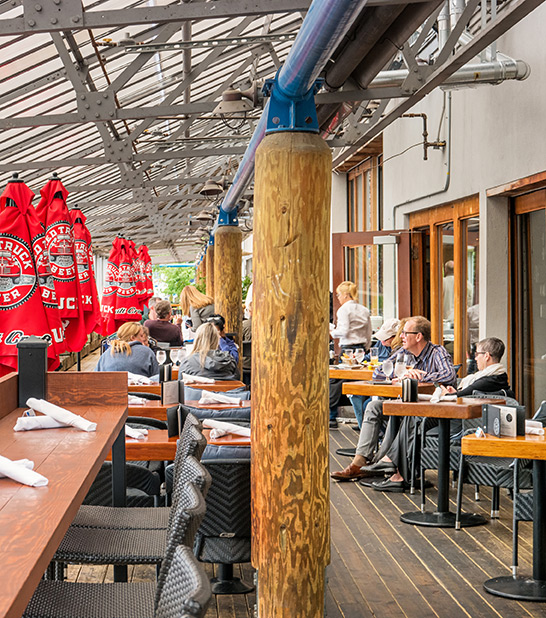
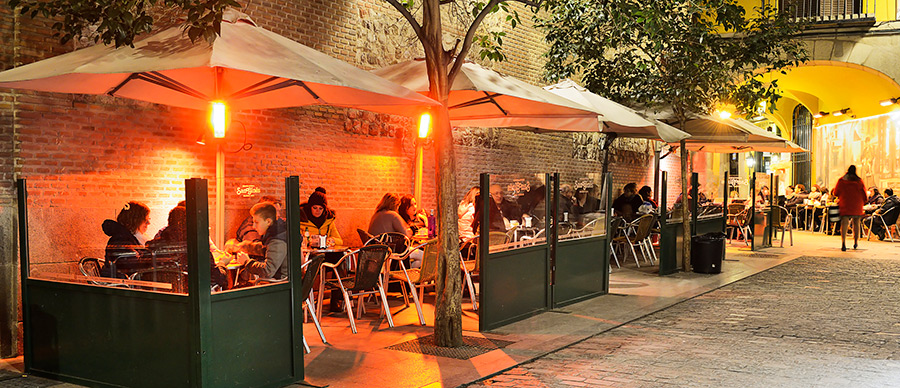
The delay of game caused by COVID-19 has many on thin ice. Patios have been a boon to weather the storm. Extending patio season into the colder months is essential to maximize capacity. Canadians understand cold and willingly brave it for entertainment — think hockey, skiing, skating, and sledding, to name just a few. Being prepared in all these sports is vital to success.
The lineup
“If operators can make it work, extending patio season is a source of revenue. It’s that simple. Restaurants right now are in a situation where they have accumulated a lot of debt over the last six to eight months. Anything that can bring in revenue and get them back to profitability is important,” says James Rilett, VP Central Canada for Restaurants Canada.
“If operators can make it work, extending patio season is a source of revenue. It’s that simple.”
James Rilett, VP Central Canada for Restaurants Canada
What will it take to be successful?
Rilett says, emphasizing the three Cs, “Capital, clear rules and customers.”
“The capital or investment and infrastructure, if needed, might be difficult for some operators but worth the effort.”
Your checklist… at a minimum
- Ensuring you have the required space for a cold weather patio
- Finding suitable tables and chairs, wind breaks, and heaters
- Making doorway adjustments
- Finding mats suitable for the elements and winter weather-ready vests for serving staff
“It’s imperative that operators clarify and understand the rules and regulations set out by their municipality to operate a patio beyond the typical season,” Rilett adds.
These R and Rs include space restrictions, operation times and acceptable equipment (heater types). Reach out to your local government to confirm understanding, if required. It’s in your communities’ best interest to be successful.
“Finally, customers need to embrace the change,” says Rilett.
The game plan
Comfort. For customers, definitely, but also for staff. Remember, comfort is both physical and psychological.
“For customers to embrace the change, operators must make it as comfortable as possible,” says Rilett. “Wind breaks, heaters and hot drinks on the menu but also through marketing initiatives like (BYOB) ‘bring your own blanket’ to make it inviting and a destination/experience.”
Bright and warm lighting, fabrics and music all add to the feel of the space and create a non-temperature warmth.
“It will be difficult on staff moving repeatedly between warm to cold. It’s imperative to keep your staff comfortable braving the elements,” says Rilett. Providing branded toques and vests, an allowance for boots, or setting shifts to rotate between patio and indoor dining can ease their minds and reduce their exposure.
Remember to share safety protocols with customers and staff repeatedly for their mental comfort. Make sure customers know your operation cares for their wellbeing and their community.
How do you know it’s working? “If people are willing to come there and Instagramming and telling their friends about it, it’s a success,” says Rilett.

Breakaway
No matter the weather, customers crave great food.
Rilett reminds us, “Adapt your menu to outdoor dining. Offer more soups and stews, hot toddies, hot drinks. Maybe, don’t offer fries.”
Yes, it’s about taste, but it’s also about the three Ts: transport, texture, temperature.
Transport
How is the food delivered to the table? Use insulated mugs (branded, of course), ceramic bowls that can be preheated (those with lids are even better), and embrace extra layers like cozies or napkins to retain heat.
Texture
What foods should be the stars of your winter patio? Baked, stewed, braised, roasted — just the words evoke warmth. How about patio-only specials? Soups you can sip paired with comfort-filled sandwiches and wraps or hearty baked items that retain heat (such as smoky butternut squash mac and cheese, chicken black bean enchiladas, turkey pot pie).
Temperature
Add a selection of hot beverages with and without alcohol to increase the temperature — think house-mulled wine, chai spiced hot chocolate, caramel apple cider, maple walnut latte, and teas.
Heat up dessert selections, too. Fresh from the oven cookies, hot pear crisp with warm caramel sauce, warm hand pies are only a few examples.
“To extend patio season, almost every part of the business will be affected, from adjusting table configurations so indoor diners don’t sit next to a cold door area to special patio-only menu items,” says Rilett.
Face off against the weather and put your patio into overtime. Be creative. Make it comfortable. Be memorable. Game on!
Heat up your patio with creative twists
- Toque night — the crazier the better and get staff involved.
- Scarf it up — wrap up necks and scarf down great food.
- BYOP — bring your own pillow. Go beyond blankets and encourage your customers to bring their own comfort options.
- Hot stones — create the Zen of warmth.
- Inside out — warm up with a hot sauce challenge.
- Ice ice baby — think oysters, caviar.
- Hand and foot warmers — warm hands, warm heart. Provide disposable hand/foot warmers or invest in rechargeable (and cleanable) ones.
- Brain buckets — trivia nights, winter sport-themed, helmets optional.

Bruce McAdams is the Associate Professor, School of Hospitality, Food, and Tourism Management, Gordon S. Lang School of Business and Economics at the University of Guelph. After coming from a background in foodservice — working three decades in restaurants as a dishwasher, cook, kitchen manager, general manager, and VP of Operations at Oliver & Bonacini — he moved to education in 2009. With his deep industry experience, McAdams figures he’s something of an inside expert on tipping.
He’s been studying the subject — from both a business and societal perspective — for nearly a decade. In a TED talk, he argued that the “relationship between tipping behaviour and quality of service is very insignificant.” People are used to tipping a certain percentage whatever the quality of service. A 2016 study conducted by McAdams and Prof. Michael von Massow, Department of Food, Agricultural and Resource Economics, found that tipping, in fact, causes challenges ranging from quality control to pay inequity.
Question: What got you interested in tipping in the first place?
Answer: My interest in tipping is now in its third incarnation. I think tipping is highly opinionated (so many different opinions around the practice) and misunderstood. It’s become my focus — and I believe I am only one of two or three academics who study the organizational dynamics of restaurants — even though, when I was working in the business I never questioned the practice.
I think tipping creates an unfair compensation system for workers in the restaurant business. For example, cooks and managers often play just as big of a role in a customer’s experience, but may not get the monetary benefits the wait staff does.
Question: Tipping has been in the news lately as some restaurants turn to a no-tipping or tip-included policy/service charge. Was COVID-19 the tipping point, or were restaurants going this way anyway?
Answer: Two really big things happened this spring. One is COVID and one is the attention to social justice issues in North America. With the first, when COVID hit restaurateurs, owners had the time to reflect on an archaic system. The system really has not changed in 30-50 years. Everything from our pricing to costing to rent to fixed costs has pretty much been the same. With COVID, we really had to go deep and look closely at systems. COVID pointed out the inequities. Also, Black Lives Matter. Tipping is discriminatory, with sexist overtones, so that became an issue as well. Tipping was accepted in the industry, but in the last 10 years people have been questioning it.
The system really has not changed in 30-50 years. Everything from our pricing to costing to rent to fixed costs has pretty much been the same.
Bruce McAdams, Associate Professor, School of Hospitality, Food, and Tourism Management, Gordon S. Lang School of Business and Economics at the University of Guelph
Question: Is tipping, in fact, an outdated practice?
Answer: It is. It’s been proven to have so many negative effects. With almost every operator, if I ask them the question — if God were able to create restaurants tomorrow, would you have tipping as part of the business model? — they’d say no. It’s a poor model because of inequity in pay, lack of revenue control, and it’s discriminatory in some respects.
Another huge impact is that tipping is concerned about what’s best for servers versus what’s better for the restaurant. A bartender will give a free drink to get a better tip. A server won’t serve a guest in another section. In a no-tipping restaurant, everyone’s success is based on all guests’ success.
Question: You say that tipping entrenches inequities. In what way?
Answer: You have to have two compensation systems. The regular system and the three-headed monster of tip-sharing, which is hugely concerning if managers are taking control of tips. It presents a huge CRA issue, and it takes hours and hours and hours of spreadsheets to say who’s making what. Some managers give their favourite servers the best sections and that creates issues between servers. The biggest issue is that it not only affects organizations but the entire industry. It creates transience in the industry because there’s no vested interest in the business. The server earns some money, then goes to travel. The cook studies for two years, then has to quit because of earning only $15/hour.
Question: How did we get tipping anyway?
Answer: There was tipping in Europe first, then it was brought here. It became lucrative for servers to earn a gratuity. In Europe there wasn’t this schmoozefest. Here friendly servers became a competitive advantage. Then along came places like Hooters, with the sexualization of servers. We evolved into this. It is a system that no one wants to be the first to go away from, but the tide may be turning.
A recent Canada-wide survey conducted by Sylvain Charlebois at Dalhousie University suggests that many Canadians (56% of respondents) are now in favour of including tips in menu prices. In a 2016-2017 Angus Reid study, it was only 36%, so there is a significant increase, some of it is because of COVID.
Question: How are consumers reacting to the change with some restaurants moving away from tipping? Will it take them long to adjust or are they pivoting as quickly as restaurants are these days?
Answer: Pre-COVID, I wouldn’t have seen us moving away from tipping. There is precedent in other countries, like France. I honestly didn’t think it would take root here, but an Angus Reid study shows that younger people are more accepting of no tipping and are more sensitive to social justice issues.
Question: If a restaurant decides to go this route, how should it communicate the change?
Answer: When Earls opened a new concept called Earls.67 in Calgary in 2016, they added a 16% service charge, and some people were angry because they felt they were being told how much they were allowed to tip. Six months later, the restaurant was forced to back down. So, many people who wanted to go to no-tipping got off on wrong foot with a built-in service charge.
Communication is the most important thing — on the menu, on the website, when you’re seating people, when you’re talking to your staff — explaining why, explaining how to handle questions. It’s a lot of talking, talking, talking. Reinforce the reason: to provide a living wage for all employees. It’s a huge decision that takes a lot of time and thought. Even restaurants doing it will need to continually revisit the decision.
Important link
- For more information read: Have restaurants reached the tipping point?
Tipping has rattled restaurateurs for years, as they struggle with the merits of tipping and tipping policy. Are tips shared? How are they factored into servers’ wages? What’s the split between front and back of house? What are the tax implications?
Most diners in Canada have accepted the practice for years and use it to reward good service, but every now and then there are rumblings of change in this age-old practice.
This could be one of those times.
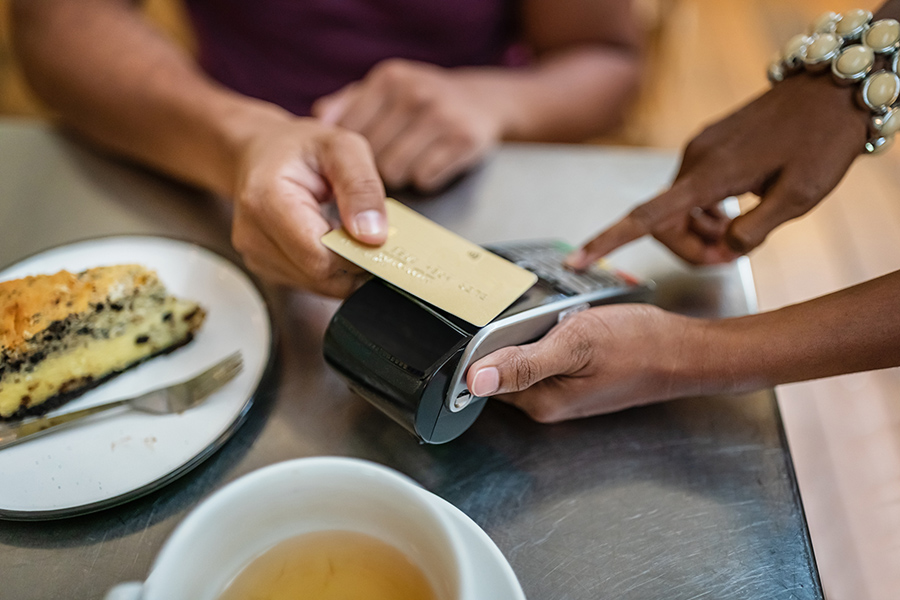
2020 and the coronavirus pandemic may have brought tipping into focus as restaurants that closed are slowly reopening and trying to return to some semblance of normality. With increasingly contactless encounters, how do restaurants and their guests handle gratuities? And is there a sea change in the way diners view gratuities?
A recent Canada-wide survey conducted by Sylvain Charlebois at Dalhousie University suggests that more than half of Canadians (56% of respondents) are now in favour of including tips in menu prices. In a 2016-2017 Angus Reid study, it was only 36%, so there is a significant increase, some of it likely because of COVID-19.

This is music to the ears of Bruce McAdams, the Associate Professor, School of Hospitality, Food, and Tourism Management, Gordon S. Lang School of Business and Economics at the University of Guelph. “I think tipping creates an unfair compensation system for workers in the restaurant business. For example, cooks and managers often play just as big of a role in a customer’s experience, but may not get the monetary benefits the wait staff does,” he says.
A 2016 study conducted by McAdams and Prof. Michael von Massow, Department of Food, Agricultural and Resource Economics, found that tipping, in fact, causes challenges ranging from quality control to pay inequity. He’s seeing a resurgence of interest in the issue.
“I think tipping creates an unfair compensation system for workers in the restaurant business.”
Bruce McAdams and Prof. Michael von Massow, Department of Food, Agricultural and Resource Economics
“Two really big things happened this spring,” he says. “One is COVID and one is the attention to social justice issues in North America. With the first, when COVID hit restaurateurs, owners had the time to reflect on an archaic system. The system really has not changed in 30-50 years. Everything from our pricing to costing to rent to fixed costs has pretty much been the same. With COVID, we really had to go deep and look closely at systems. COVID pointed out the inequities. Also, Black Lives Matter. Tipping is discriminatory, with sexist overtones, so that became an issue as well.”
A sea change? Not so fast
Does this mean we’ll be seeing a wholesale change in the way gratuities are handled? A few Canadian restaurants have announced a new no-tipping policy, but so far, the “trend” has not taken hold. At the same time some guests are making a point of tipping more to help offset the financial difficulties servers may have suffered under the pandemic.
“This topic has come up several times, but it has not gained traction,” says Jeff Dover, president of fsSTRATEGY. “In restaurants, service charges have been added for larger groups (i.e., six or more). The service charge started at 10% of sales and has increased significantly. Issues arrise when the service is not good (whether or not it was the server’s fault) and the gratuity or service charge is included. The argument, rightly or wrongly, was that the server knows the tip, and might work to increase it by upselling, however, is not under an incentive to provide good service.”
Building service or tips into the pricing may also put a restaurant at a disadvantage, he adds, compared to other restaurants that don’t follow the practice, since prices will be higher.
Servers are also not generally in favour of built-in service charges, Dover notes, especially when the restaurant institutes tipping pools, since the tips may be added to pay checks and are subject to income tax. “While transparency of tipping is changing as more and more gratuities are processed using credit and debit cards as opposed to cash, not all servers report all tips as income.” In addition, some guests may be put off by the sticker shock of another value-added tax appearing on their checks.

Are tips here to stay?
While more and more restaurant dining is being done off-premises and we are seeing an increase in fast casual concepts where tipping is not as ingrained as in full-service, industry watchers like Jeff Dover think that tipping will remain the norm in full-service restaurants.
Even no-tipping pioneer Danny Meyer has returned to a tipping policy, but with a difference. In 2015, Meyer, the entrepreneur behind New York’s Union Square Hospitality Group, eliminated tipping as being an inequitable practice. But with restaurants reopening under COVID-19, even the pioneering Meyer has rethought his no-tipping policy in favour of tips — but with a sharing component added.
Tipsheet
If you do decide to change your tipping strategy, how do you communicate the new policy?
For front-of-house and back-of-house staff
- Let staff know what the new plan is and how it will affect them.
- Be clear with how much and when staff will receive the tips. Currently, receipt of tips is instant (i.e., the day of the shift or the next shift if staff leave early).
- Make sure to train staff in communicating the tipping messaging to the customers.
For guests
- Let guests know how the system works and that all service charges added to checks are going to those who prepared and served their meals as opposed to managers and/or the restaurant operators.
- Be clear in communicating your reasons for making the change — to provide a living wage for all employees in a fair and consistent way.
Don’t forget to revisit your decision. Times change, as we’ve all learned with the COVID-19 pandemic.
Important link
- For more information read: Q&A with Professor Bruce McAdams
How are servers — and other restaurant staff — connecting with guests now that they have to wear face masks and avoid contact? And how do guests know when servers are smiling?
The personal touch is a key part of the restaurant experience, but new safety protocols have upended that experience. Servers need to work extra hard to create that feeling of welcome. Has the thumbs-up become a new form of communication between servers and guests to signify satisfaction? Or has “eye talk” become the norm? And how are operators training staff to replicate the warm, welcoming feeling of the “old days“?
“Smiling is part of service.”
Jeff Dover, Principal at fsStrategy Inc.
“Smiling is part of service,” says Jeff Dover, Principal at fsStrategy Inc. “So, with masks, eye contact is important.“
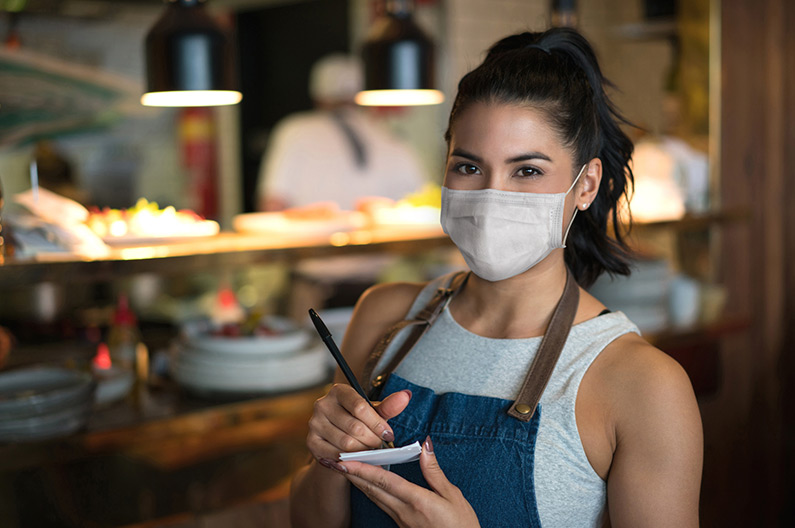
Masks can be adapted, he adds:
Top Tips
- Customize the mask with a smile on it or something appropriate to your brand —have some fun with it and turn it into something positive.
- “I have seen masks with clear plastic in the mouth area allowing for smiles.“
- Have staff wear a pin or button with their picture on it (smiling and friendly of course).
- “The first customers (are) comfortable dining out and looking forward to it,” he adds. “The next wave will include diners that are a little tentative and worried. Service, as we perceive it, will change.“
Changes to server communication need to be part of a bigger strategy of letting guests know what you are doing to keep them safe.
Here are other tips from Dover for servers adjusting to the new restaurant normal. Many of them, you have probably already instituted:
Top Tips
- Don’t pre-set tables. Bring sanitized salt and pepper, cutlery etc. after guests have been seated.
- Have sanitizer in the dining room at all server stations.
- Make sure servers sanitize regularly — after placing orders, etc.
- Offer wrapped plastic cutlery for those who request it (many won’t take you up on it if you have regular cutlery, but the offer will be good for those a little uncomfortable and will show all customers you care about their health.
- Use disposable menus. Servers should make a point of letting guests know that menus will not be used again.
- Have your menu available online and mobile friendly for those who don’t want to touch menus.
“…it is about making people feeling comfortable dining again,” Dover says. “I also think thanking them for coming back and supporting your business will go a long way and be appreciated.“
Is it all doom and gloom? According to projections by the Canadian Chamber of Commerce (based on Statistics Canada research), 60% of operators are at risk of closure by the end of 2020. Dark clouds continue to gather on the horizon: the prospect of a reduction in various government support programs; a six-month hiatus in patio dining over the fall and winter; and a likely second wave of the virus.
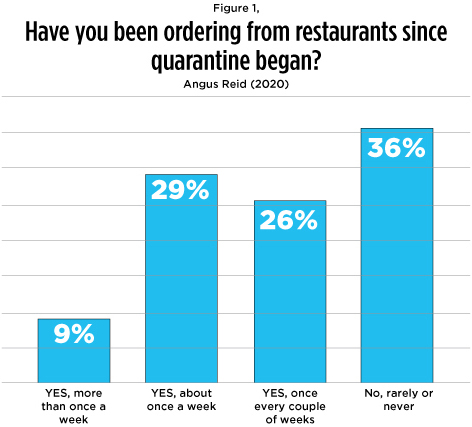
To better understand the mood and attitudes of Canadian consumers with respect to COVID-19, the Agri-Food Analytics Lab at Dalhousie sponsored a detailed research project conducted by Angus Reid in June 2020.
A total of 1,505 Canadians were surveyed. They were asked if they had been ordering food from restaurants during the pandemic and if they intended to return to their old habits afterwards. The survey also measured consumer expectations in terms of using foodservice in the rest of the year.
Behavioural impacts of COVID-19 — key insights
The good news
- Two-thirds of Canadians kept ordering food regularly from restaurants during the pandemic. A total of 64% of Canadians had ordered food at least every two weeks from a restaurant.
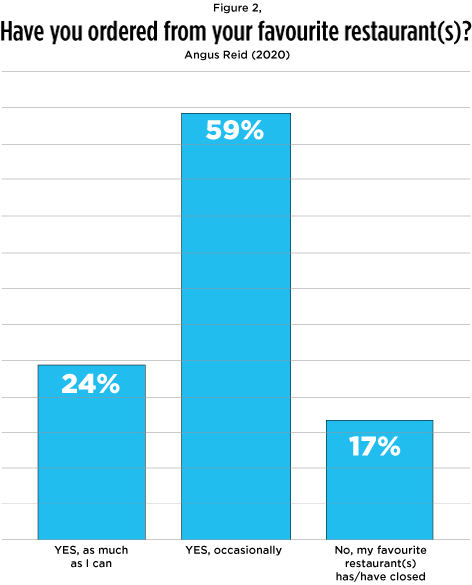
- A total of 83% of Canadians ordered from their favourite restaurant during the first three months of the pandemic.
- Younger people were more likely to order out from a restaurant. A total of 81% of respondents between the ages of 18 and 34 years old had ordered from restaurants, the highest rate among age groups.
- About 29% of Canadians ordered from restaurants at least once a week, and 9% had ordered food once a week since the beginning of the pandemic.
The bad news
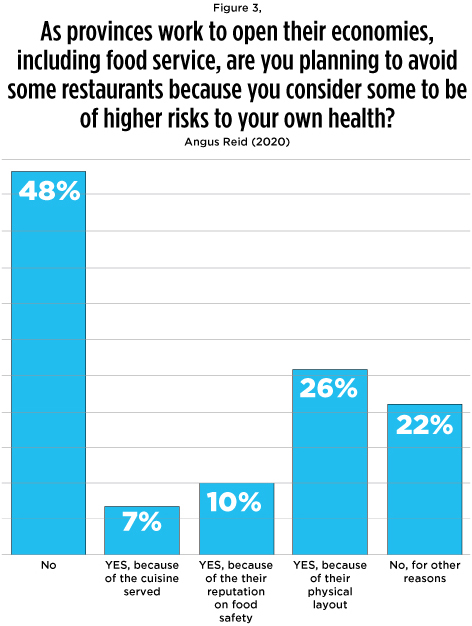
About half of Canadians were hesitant to resume restaurant patronage to protect their own health.
- Physical layout appears to be the most important issue for people.
- About 10% of Canadians say they will avoid establishments due to their food safety reputation.
- And about one-fifth of Canadians will avoid establishments for an undisclosed reason.
Bottom line for operators is the need to invest in changes to your physical environment and perceived service level to build trust. Consistency and commitment in the implementation of these changes will enable you to gain and keep consumer confidence.
Meeting and managing expectations
In the Dal Agri-Lab survey Canadians were asked what they expect to see when they return to their restaurant of choice. The overwhelming majority of respondents said they expected to see more personal protective equipment worn by staff, and measures taken to separate/protect diners (e.g. more plexiglass).
Interestingly, there was also an appreciation for the challenges faced by operators to maintain safety and manage the circumstances. Nearly 40% of Canadians said they expected slower service and 29% expect menu changes or fewer choices.
Author of the Dal Agri-Lab study, Professor in Food Distribution and Policy at Dalhousie University Sylvain Charlebois estimates that up to 30% of lost restaurant revenue in 2021 could be a result of people working from home. “The more people work from home, the less likely they are to spend money on food and beverages at local restaurants.”
“The more people work from home, the less likely they are to spend money on food and beverages at local restaurants.”
Sylvain Charlebois, Professor in Food Distribution and Policy at Dalhousie University
The road forward will depend on both governments and operators helping themselves by doing what is needed to optimize the safety of foodservice in order to convince guests that it is safe to return to restaurants.
Foodservice has already been buffeted by unparalled difficulties as a result of COVID-19. A survey of operators by Restaurants Canada at the end of March 2020 revealed that one in 10 restaurants in Canada had already closed permanently — roughly 10,000 businesses that had decided not to reopen. Charlebois adds, “We are expecting the industry to lose $20 billion, on top of what actually happened this spring. In a year from now, 25% of all restaurants will disappear.”
Though many more operators may be forced to close by 2021, the industry will endure. However, reduced meal occasions and altered consumer behaviour may be with us for the long haul.