
Consistency in the guest experience is a winning factor for successful restaurant brands. From menu execution, service levels, to ways the staff are presented, guests return to restaurants where their experience consistently meets their expectations.
Traditionally, restaurants enforced staff uniforms such as matching pants, shirts and branded aprons, as a way to provide consistency in their teams’ visual appearance and the restaurant brand experience. Lately, though, the idea of the traditional uniform has evolved as more restaurant brands encourage staff to express their individuality, while following brand guidelines.
The “non-uniform” uniform concept can be tricky to navigate. How important is a uniform to your overall restaurant brand? VERY, and here’s why!
Customer experience is becoming the new competitive brand advantage, and what’s eye opening is that 80% of companies believe they deliver “super experiences,” but only 8% of customers agree. Everything a restaurant brand does, including how the team is presented, influences the overall customer experience, according to Forbes.com.
A uniformed team look provides regularity in your staff’s appearance, helping diners identify who actually works for the establishment from other patrons. Being able to easily pinpoint staff is important to the overall guest experience. Some restaurant brands go one step further to have a defined or elevated management dress code, to clearly define for guests who is in charge!
A uniformed team look provides regularity in your staff’s appearance, helping diners identify who actually works for the establishment from other patrons.
Here is a harsh truth about restaurant guests: they are judging your front-of-house staff on their appearance and how it relates to the service level of your operation. For this reason, fine dining restaurants traditionally impose a strict uniform standard, where each staff member is identically dressed in a polished manner, reflective of the refined dining experience. This is what guests have come to expect in this category of restaurants, so it is important to factor in how your team’s attire represents your restaurant’s level of service.
- TIP: Align your attire to your brand
Uniforms also support the overall brand experience, so even if you are developing a “non-uniform” uniform, ensure that your attire guidelines align with the restaurant’s vibe and atmosphere. If you are operating a fun casual pub, then your staff’s attire should match that.
North Winds, a craft brewer and casual eatery, has taken this approach and gives their staff freedom to choose what they wear on the bottom in terms of pants, shorts, skirt and footwear, but provides them with a North Winds shirt that is mandatory from Saturday to Thursday. On Fridays, however, the staff are encouraged to wear a shirt from another craft brewer to support the industry while letting the team showcase their beer interests and personal style.
So how do you design and regulate the “non-uniform” uniform?
- TIP: Create a dress code for your restaurant brand and your staff
Most importantly, maintain your brand image, because your staff’s appearance should never hinder your restaurant’s reputation. Begin by defining and upholding a clear dress code standard that emphasizes professionalism and cleanliness, while supporting a “non-uniform” diverse concept. Your guests will appreciate this and it sends a strong signal to your staff that your restaurant brand and how customers perceive it, is important to the business’ overall success.
Seasonal weather shifts, the flow of service, plate and tray sizes, tableside experiences, ordering standards, and restaurant design will impact what your team can wear to comfortably and safely perform their duties. Reference workplace safety laws to ensure your standards align with best practices.
Regulating your staff’s unconventional uniform can sometimes lead to uncomfortable chats. To avoid misinterpretation, provide examples of what is acceptable and what is not, and how your team can vary their work style while maintaining brand consistency. Jenny Companion, VP of Eastern Operations at The Fifteen Group, recommends providing retailer suggestions and picture examples of looks that match the attire standards.
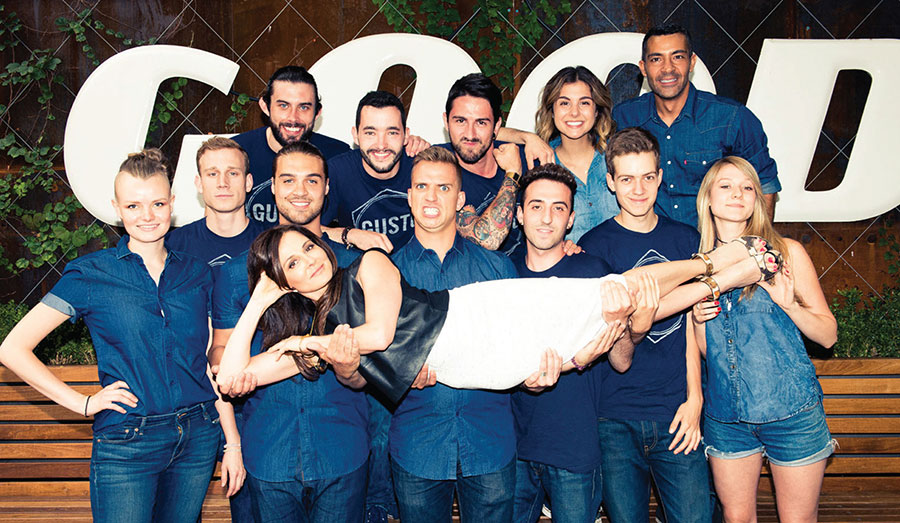
Gusto101 in Toronto designed the ideal “non-uniform” uniform that maintains the overall brand image and feel. Gusto’s wait staff and bartenders dress in blue denim shirts, or a blue branded t-shirt, and jeans, but the brand choices and style choices are all theirs. Guests are still able to identify who works at Gusto, employees can be comfortable in their own clothing that fits their shape and style, and the restaurant saves on uniform costs; it’s a win-win!
“Going with the ‘non-uniform’ uniform for your restaurant can be a fun way to express staff individuality while maintaining your brand,” says Gusto owner and chef Janet Zuccarini, “but it is still important to understand the rules around who covers the cost of the uniform, even if it isn’t head to toe.”
Be sure to read up on Canada’s latest Employment Acts that outline this useful information.

Bruce McAdams is the Associate Professor, School of Hospitality, Food, and Tourism Management, Gordon S. Lang School of Business and Economics at the University of Guelph. After coming from a background in foodservice — working three decades in restaurants as a dishwasher, cook, kitchen manager, general manager, and VP of Operations at Oliver & Bonacini — he moved to education in 2009. With his deep industry experience, McAdams figures he’s something of an inside expert on tipping.
He’s been studying the subject — from both a business and societal perspective — for nearly a decade. In a TED talk, he argued that the “relationship between tipping behaviour and quality of service is very insignificant.” People are used to tipping a certain percentage whatever the quality of service. A 2016 study conducted by McAdams and Prof. Michael von Massow, Department of Food, Agricultural and Resource Economics, found that tipping, in fact, causes challenges ranging from quality control to pay inequity.
Question: What got you interested in tipping in the first place?
Answer: My interest in tipping is now in its third incarnation. I think tipping is highly opinionated (so many different opinions around the practice) and misunderstood. It’s become my focus — and I believe I am only one of two or three academics who study the organizational dynamics of restaurants — even though, when I was working in the business I never questioned the practice.
I think tipping creates an unfair compensation system for workers in the restaurant business. For example, cooks and managers often play just as big of a role in a customer’s experience, but may not get the monetary benefits the wait staff does.
Question: Tipping has been in the news lately as some restaurants turn to a no-tipping or tip-included policy/service charge. Was COVID-19 the tipping point, or were restaurants going this way anyway?
Answer: Two really big things happened this spring. One is COVID and one is the attention to social justice issues in North America. With the first, when COVID hit restaurateurs, owners had the time to reflect on an archaic system. The system really has not changed in 30-50 years. Everything from our pricing to costing to rent to fixed costs has pretty much been the same. With COVID, we really had to go deep and look closely at systems. COVID pointed out the inequities. Also, Black Lives Matter. Tipping is discriminatory, with sexist overtones, so that became an issue as well. Tipping was accepted in the industry, but in the last 10 years people have been questioning it.
The system really has not changed in 30-50 years. Everything from our pricing to costing to rent to fixed costs has pretty much been the same.
Bruce McAdams, Associate Professor, School of Hospitality, Food, and Tourism Management, Gordon S. Lang School of Business and Economics at the University of Guelph
Question: Is tipping, in fact, an outdated practice?
Answer: It is. It’s been proven to have so many negative effects. With almost every operator, if I ask them the question — if God were able to create restaurants tomorrow, would you have tipping as part of the business model? — they’d say no. It’s a poor model because of inequity in pay, lack of revenue control, and it’s discriminatory in some respects.
Another huge impact is that tipping is concerned about what’s best for servers versus what’s better for the restaurant. A bartender will give a free drink to get a better tip. A server won’t serve a guest in another section. In a no-tipping restaurant, everyone’s success is based on all guests’ success.
Question: You say that tipping entrenches inequities. In what way?
Answer: You have to have two compensation systems. The regular system and the three-headed monster of tip-sharing, which is hugely concerning if managers are taking control of tips. It presents a huge CRA issue, and it takes hours and hours and hours of spreadsheets to say who’s making what. Some managers give their favourite servers the best sections and that creates issues between servers. The biggest issue is that it not only affects organizations but the entire industry. It creates transience in the industry because there’s no vested interest in the business. The server earns some money, then goes to travel. The cook studies for two years, then has to quit because of earning only $15/hour.
Question: How did we get tipping anyway?
Answer: There was tipping in Europe first, then it was brought here. It became lucrative for servers to earn a gratuity. In Europe there wasn’t this schmoozefest. Here friendly servers became a competitive advantage. Then along came places like Hooters, with the sexualization of servers. We evolved into this. It is a system that no one wants to be the first to go away from, but the tide may be turning.
A recent Canada-wide survey conducted by Sylvain Charlebois at Dalhousie University suggests that many Canadians (56% of respondents) are now in favour of including tips in menu prices. In a 2016-2017 Angus Reid study, it was only 36%, so there is a significant increase, some of it is because of COVID.
Question: How are consumers reacting to the change with some restaurants moving away from tipping? Will it take them long to adjust or are they pivoting as quickly as restaurants are these days?
Answer: Pre-COVID, I wouldn’t have seen us moving away from tipping. There is precedent in other countries, like France. I honestly didn’t think it would take root here, but an Angus Reid study shows that younger people are more accepting of no tipping and are more sensitive to social justice issues.
Question: If a restaurant decides to go this route, how should it communicate the change?
Answer: When Earls opened a new concept called Earls.67 in Calgary in 2016, they added a 16% service charge, and some people were angry because they felt they were being told how much they were allowed to tip. Six months later, the restaurant was forced to back down. So, many people who wanted to go to no-tipping got off on wrong foot with a built-in service charge.
Communication is the most important thing — on the menu, on the website, when you’re seating people, when you’re talking to your staff — explaining why, explaining how to handle questions. It’s a lot of talking, talking, talking. Reinforce the reason: to provide a living wage for all employees. It’s a huge decision that takes a lot of time and thought. Even restaurants doing it will need to continually revisit the decision.
Important link
- For more information read: Have restaurants reached the tipping point?
Tipping has rattled restaurateurs for years, as they struggle with the merits of tipping and tipping policy. Are tips shared? How are they factored into servers’ wages? What’s the split between front and back of house? What are the tax implications?
Most diners in Canada have accepted the practice for years and use it to reward good service, but every now and then there are rumblings of change in this age-old practice.
This could be one of those times.
2020 and the coronavirus pandemic may have brought tipping into focus as restaurants that closed are slowly reopening and trying to return to some semblance of normality. With increasingly contactless encounters, how do restaurants and their guests handle gratuities? And is there a sea change in the way diners view gratuities?
A recent Canada-wide survey conducted by Sylvain Charlebois at Dalhousie University suggests that more than half of Canadians (56% of respondents) are now in favour of including tips in menu prices. In a 2016-2017 Angus Reid study, it was only 36%, so there is a significant increase, some of it likely because of COVID-19.

This is music to the ears of Bruce McAdams, the Associate Professor, School of Hospitality, Food, and Tourism Management, Gordon S. Lang School of Business and Economics at the University of Guelph. “I think tipping creates an unfair compensation system for workers in the restaurant business. For example, cooks and managers often play just as big of a role in a customer’s experience, but may not get the monetary benefits the wait staff does,” he says.
A 2016 study conducted by McAdams and Prof. Michael von Massow, Department of Food, Agricultural and Resource Economics, found that tipping, in fact, causes challenges ranging from quality control to pay inequity. He’s seeing a resurgence of interest in the issue.
“I think tipping creates an unfair compensation system for workers in the restaurant business.”
Bruce McAdams and Prof. Michael von Massow, Department of Food, Agricultural and Resource Economics
“Two really big things happened this spring,” he says. “One is COVID and one is the attention to social justice issues in North America. With the first, when COVID hit restaurateurs, owners had the time to reflect on an archaic system. The system really has not changed in 30-50 years. Everything from our pricing to costing to rent to fixed costs has pretty much been the same. With COVID, we really had to go deep and look closely at systems. COVID pointed out the inequities. Also, Black Lives Matter. Tipping is discriminatory, with sexist overtones, so that became an issue as well.”
A sea change? Not so fast
Does this mean we’ll be seeing a wholesale change in the way gratuities are handled? A few Canadian restaurants have announced a new no-tipping policy, but so far, the “trend” has not taken hold. At the same time some guests are making a point of tipping more to help offset the financial difficulties servers may have suffered under the pandemic.
“This topic has come up several times, but it has not gained traction,” says Jeff Dover, president of fsSTRATEGY. “In restaurants, service charges have been added for larger groups (i.e., six or more). The service charge started at 10% of sales and has increased significantly. Issues arrise when the service is not good (whether or not it was the server’s fault) and the gratuity or service charge is included. The argument, rightly or wrongly, was that the server knows the tip, and might work to increase it by upselling, however, is not under an incentive to provide good service.”
Building service or tips into the pricing may also put a restaurant at a disadvantage, he adds, compared to other restaurants that don’t follow the practice, since prices will be higher.
Servers are also not generally in favour of built-in service charges, Dover notes, especially when the restaurant institutes tipping pools, since the tips may be added to pay checks and are subject to income tax. “While transparency of tipping is changing as more and more gratuities are processed using credit and debit cards as opposed to cash, not all servers report all tips as income.” In addition, some guests may be put off by the sticker shock of another value-added tax appearing on their checks.
Are tips here to stay?
While more and more restaurant dining is being done off-premises and we are seeing an increase in fast casual concepts where tipping is not as ingrained as in full-service, industry watchers like Jeff Dover think that tipping will remain the norm in full-service restaurants.
Even no-tipping pioneer Danny Meyer has returned to a tipping policy, but with a difference. In 2015, Meyer, the entrepreneur behind New York’s Union Square Hospitality Group, eliminated tipping as being an inequitable practice. But with restaurants reopening under COVID-19, even the pioneering Meyer has rethought his no-tipping policy in favour of tips — but with a sharing component added.
Tipsheet
If you do decide to change your tipping strategy, how do you communicate the new policy?
For front-of-house and back-of-house staff
- Let staff know what the new plan is and how it will affect them.
- Be clear with how much and when staff will receive the tips. Currently, receipt of tips is instant (i.e., the day of the shift or the next shift if staff leave early).
- Make sure to train staff in communicating the tipping messaging to the customers.
For guests
- Let guests know how the system works and that all service charges added to checks are going to those who prepared and served their meals as opposed to managers and/or the restaurant operators.
- Be clear in communicating your reasons for making the change — to provide a living wage for all employees in a fair and consistent way.
Don’t forget to revisit your decision. Times change, as we’ve all learned with the COVID-19 pandemic.
Important link
- For more information read: Q&A with Professor Bruce McAdams
How are servers — and other restaurant staff — connecting with guests now that they have to wear face masks and avoid contact? And how do guests know when servers are smiling?
The personal touch is a key part of the restaurant experience, but new safety protocols have upended that experience. Servers need to work extra hard to create that feeling of welcome. Has the thumbs-up become a new form of communication between servers and guests to signify satisfaction? Or has “eye talk” become the norm? And how are operators training staff to replicate the warm, welcoming feeling of the “old days“?
“Smiling is part of service.”
Jeff Dover, Principal at fsStrategy Inc.
“Smiling is part of service,” says Jeff Dover, Principal at fsStrategy Inc. “So, with masks, eye contact is important.“
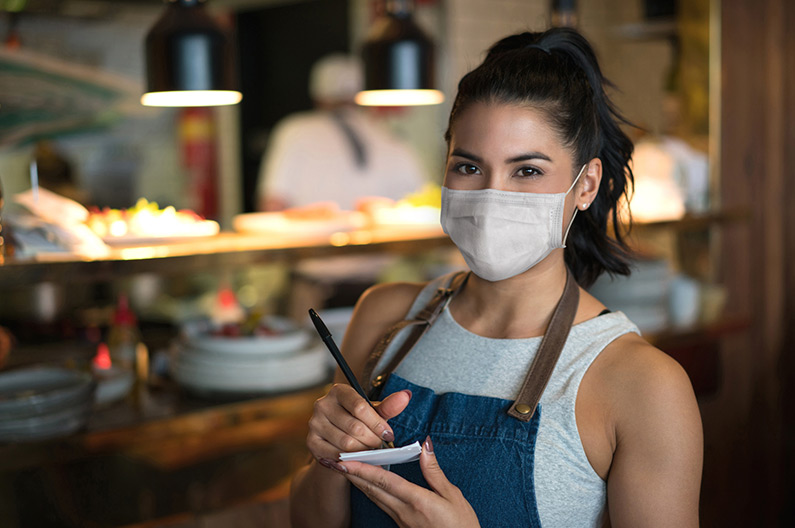
Masks can be adapted, he adds:
Top Tips
- Customize the mask with a smile on it or something appropriate to your brand —have some fun with it and turn it into something positive.
- “I have seen masks with clear plastic in the mouth area allowing for smiles.“
- Have staff wear a pin or button with their picture on it (smiling and friendly of course).
- “The first customers (are) comfortable dining out and looking forward to it,” he adds. “The next wave will include diners that are a little tentative and worried. Service, as we perceive it, will change.“
Changes to server communication need to be part of a bigger strategy of letting guests know what you are doing to keep them safe.
Here are other tips from Dover for servers adjusting to the new restaurant normal. Many of them, you have probably already instituted:
Top Tips
- Don’t pre-set tables. Bring sanitized salt and pepper, cutlery etc. after guests have been seated.
- Have sanitizer in the dining room at all server stations.
- Make sure servers sanitize regularly — after placing orders, etc.
- Offer wrapped plastic cutlery for those who request it (many won’t take you up on it if you have regular cutlery, but the offer will be good for those a little uncomfortable and will show all customers you care about their health.
- Use disposable menus. Servers should make a point of letting guests know that menus will not be used again.
- Have your menu available online and mobile friendly for those who don’t want to touch menus.
“…it is about making people feeling comfortable dining again,” Dover says. “I also think thanking them for coming back and supporting your business will go a long way and be appreciated.“