
Family-owned businesses possess many strengths, such as their ability to look at the long-term development of their operation and align interests between management and owner.
This is especially true of “owner-operator” structures often seen with independent restaurant operators. However, restaurant owner/operators also face some challenges, such as how to objectively evaluate performance and capabilities and how best to ensure talent development within the family.
In some cases, families – despite having a common base to build on and often working together day-to-day – find it difficult to conduct conversations among themselves about important financial issues. It’s very hard to disconnect emotions and be fact-based and objective in a family business. Therefore, obtaining some external impartial support can be a source of great assistance.
According to the Family Firm Institute, 70% of family businesses will not survive into the second generation and 90% will not survive to the third generation. As well, a Canadian Business Insights study from 2021 found that “only 34% of Canadian family businesses have a robust, documented and communicated succession plan in place.”
Succession planning for family-owned restaurants need not be a frightening prospect.
Here’s how you can plan your family-based restaurant for success:
Not a one-off succession plan
The first thing to understand about succession planning is that it is not a one-off exercise, but rather a way of managing the family business professionally during the business’s lifetime. In addition, this is not only about succession at the top, but throughout your entire operation. The same issues appear across the business on all levels. Having adequate processes in place is necessary for all family-owned businesses.

Start early
Engaging family to determine their personal aspirations and wishes is no small feat. It takes time and rarely proceeds in a straight line. It’s important to start early so the family’s collective goals and values can percolate over the years and lead to a broadly accepted family vision.
In multi-generational family businesses involving various branches, it’s crucial to encourage full participation of the entire family or representatives of the various family branches. Family meetings can be a productive way to promote communication, cooperation, and, most importantly, trust. Creating a board of family advisors might be a good idea. Emotions can run high when dealing with family issues. Holding regular “check-ins” can help manage the emotions around succession planning.
Prepare for your business transition
Comparing internal factors that a family can control versus external factors that are beyond a family’s control helps the decision-making process.
Internal factors within the control of the family are: the corporate structure (including the current shareholders agreement), culture, employees, business profitability, and access to financing.
External factors include changes in competition, technology, market demand, and public policy. By blending both internal and external analysis with family member communication, it should become clear whether your family should keep the business in the family or consider selling. The family should set out steps and milestones within the framework of a strategic plan.
Prepare for your personal transition
Succession planning tends to focus on technical aspects like tax and estate, while insufficient attention is paid to planning for lifestyle balance and building a new identity post-succession.
Only in hindsight do many owners realize the impact that succession of the family business creates. Inevitably, leaving the business can create a void. Some owners even haunt their former restaurant, never quite yielding control to the next generation, and, in some extreme cases, may actually disrupt the succession plan they put in place. Take the time to create your personal post-succession life plan.
Work with the right team of advisors
Given the generation-to-generation nuances of a family-owned business, choosing the right type of support is critical. Typically, succession planning issues appear across generations, so it’s useful if you already work with a trusted advisor, with that trust spanning across multiple generations of family members. Your trusted advisor can head up a larger team of specialists (such as an accountant, lawyer, banker and insurance broker) skilled in succession planning itself, but also in related key areas such as talent and career planning, skills development, governance, communications, and role definition across the generations.
Quick tips to plan for family business transition
- Establish timelines to keep on track.
- Set milestones for achieving goals.
- Keep your succession plan up to date.
- Review your plan at least once a year to reflect changes.
- Prepare a communication plan to notify your successors, staff, suppliers and customers of your succession plans.
- Work with professional advisors.
With the coming of cooler days, getting ready for a return to more inside dining is an annual practice in the foodservice business. Autumn is a time to begin scaling back patio operations and introducing more menu items that use the bounty of the harvest to best advantage.
It’s also a good time to review operational procedures, says consultant Lionel Morey of Vancouver Island Hospitality Consulting. “Why not initiate a conversation with your trusted foodservice rep to pick their brain on trends, ideas, or new products? I spoke to a manager who was thrilled his rep mentioned transitioning them away from liquid fuel-based votive inserts for their tables to rechargeable ones – an upfront cost that paid for itself in less than one winter.”
The end of summer usually means big staffing changes, too, as many employees head back to school or embark on other life changes. Look carefully at how many team members you will need based on your sales projections and then determine how many you need to hire and when you need to start training them. Slightly shorten shifts to retain more key staff over the downtime and avoid paying overtime.

Restaurant patio’s winding down, now what?
Create a checklist of what needs to be done for winter storage for the furniture, flower pots, and outdoor host stands/bars/side stations. “I have a client who donates the flowers to a local seniors’ facility who has room for them and she picks them up in the spring – a win-win! Just remember for the furniture to check the manufacturer’s specs on cleaning and storage, and a basic rule of thumb is clean/dry/stack/store ideally in a warm, moisture controlled room,” Morey says.
Consider a covered and heated patio. It’s a great way to attract those guests not ready to return indoors, says Jenny Companion, VP eastern operations for hospitality consulting agency The Fifteen Group. “It also provides more options for operators should there be any changes to indoor dining restrictions.”
If your traffic slows in the fall, the season is a perfect time to schedule a deep clean and complete repairs, upgrades and seasonal maintenance. Consider smaller details, too, like updating your music playlist, auditioning live entertainment, and trying out an alternative seating plan.
Change is in the air
Fall may be the perfect time to consider changes to seating styles and layouts, Companion says. “Replacing fixed seating with more flexible chairs and tables may be a good way to accommodate more guests and a smart investment for the fall and cooler temperatures when guests choose the indoors. Being flexible should restrictions change will be an asset for operators.”
“Replacing fixed seating with more flexible chairs and tables may be a good way to accommodate more guests and a smart investment for the fall.”
Jenny Companion, VP eastern operations, The Fifteen Group
Now is also the time to start thinking about the return of large groups and holiday season celebrations, Companion says. “Being prepared is the key to selling this type of business and capitalizing on opportunities.”
Showcase the bounty of the harvest
It’s never too early to start planning a fall menu built around some key considerations:
- Locally/regionally-sourced fruits and vegetables, the essence of fresh and good.
- Comfort food classics like mac and cheese.
- Desserts loaded with fruits of the season – pies, puddings, cobblers, and more.
- Incorporating savoury spices that warm and wow.
- Announcing your fall menus on social media.
Don’t forget that a $3 head of cauliflower turns into a $7 head in January, so sharpen your pencil and cost out with the peak numbers you’ll be seeing. “Involving your suppliers in these conversations can save a lot of grief,” Morey advises.
Recharge!
If you are a seasonal operation and fall and winter are your downtime, take the opportunity to find that elusive work/life balance. “Send your chef on an R&D trip to see what’s hot, plan that management getaway that’s heavy on fun and light on work, and just step away from your business as much as possible to diminish the fatigue and burnout so often associated with restaurants,” says Morey.
Let loose a little
Prepare for the days (and nights!) when restrictions are lifted and people are allowed to gather indoors again. Pubs have success with open mic night or a comedy show, diners have quirky promotions that guests love like “flip a coin and you pay double or nothing,” or do food challenges, Morey says.
“Upscale cocktail lounges can offer a “dealer’s choice” drink special or feature industry experts for a fun night of Q&A with guests or more typically other industry folks. Late night offerings are rapidly growing as well so let your teams involve the more junior staff in these promotions and they benefit from both the experience and camaraderie – a real team building exercise.”
COVID-19 considerations for restaurants
With COVID-19, there’s a lot more to consider, and careful planning and attention to detail are even more crucial.
- Various health bodies including the Canadian Centre for Occupational Health and Safety recommend that all customer parties remain at least two metres (six feet) apart. Where that is not possible, certain tables and chairs can be marked as unavailable for use.
- Where practical, separate booth seating with physical barriers such as clear acrylic plastic or plexiglass. Temporary table dividers may be installed to make social distancing easier for restaurants with communal seating or larger tables.
- Create separation from action stations or open kitchens. Separate guests from the kitchen or plating team with high, clear dividers if the distance between guest and staff is less than two metres.
- Install physical barriers, such as sneeze guards and partitions, particularly in areas where it is difficult for individuals to remain at least two metres apart. Barriers can be useful in restaurant kitchens and at cash registers, host stands, or food pickup areas where maintaining physical distance is difficult.
- So that people can speak as quietly as possible and reduce aerosol transmission, reduce noise levels as much as possible including turning off or down the volume of background music. Suspend live music and performances.
- Configure order pick-up areas in such a way as to provide the greatest possible distance possible (minimum two metres) between guests and employees. Use floor markings for clarity.
- Modify payment pads to have long handles to help employees and guests maintain greater separation.


Thinking ahead
- Offer drive-through, curbside takeout, or delivery options as applicable.
- Ask customers to wait in their cars or away from the establishment while waiting to pick up food or when waiting to be seated.
- Discourage crowded waiting areas by using phone app, text technology, or signs to alert patrons when their table is ready.
- Consider options for dine-in customers to order ahead of time to limit the amount of time spent in the establishment.
- Provide a weather permitting overflow waiting area outside, if possible.
- Replace traditional menus with easy-to-disinfect, laminated menus or replace them with one-time use paper sheets.
- Temporarily suspend self-serve options that require using shared utensils such as salad bars, breakfast bars, or buffets.
- Provide physical guides, such as tape on floors or sidewalks and signage, to ensure that individuals remain apart, especially where lines form.
- Have cutlery, condiments, napkins, and other items behind a counter and available upon request instead of in communal dispensers.
Masking
Health and safety remain very important in the consumer’s mind. It’s important to follow provincial and municipal guidelines and to post and communicate your actions to your customers, Companion says. “Beyond that, the key importance is to stay diligent with enforcing these restrictions for the safety of your staff.”
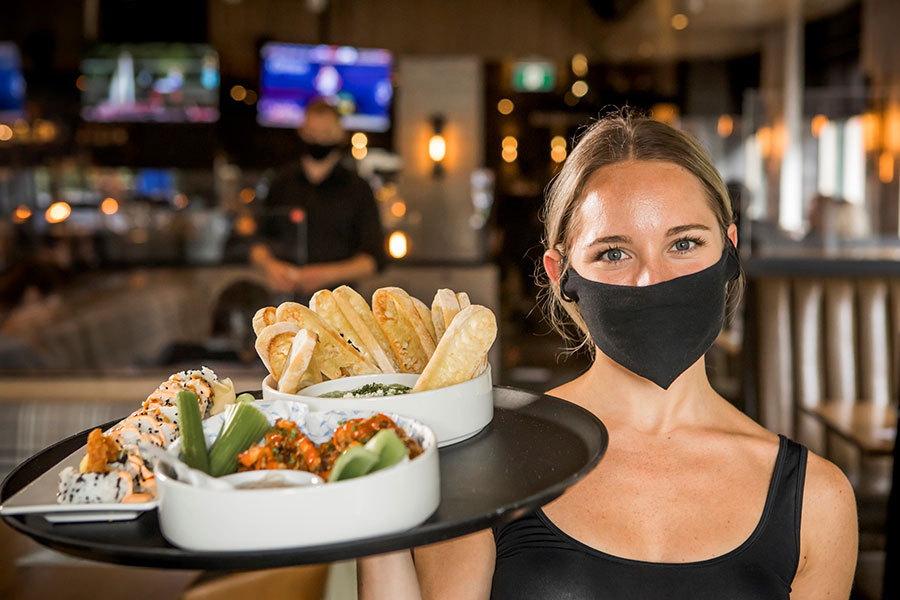
The CCOHS recommends that all foodservice operators implement a mask-wearing policy. Require employees to properly wear well-constructed and well-fitting masks. Masks should cover the nose, mouth, and chin without gaps.
Vaccines
- Encourage employees to get the COVID-19 vaccine as it is eligible and available in your jurisdiction.
- Share additional information on the vaccine by posting it on your premises or sharing it electronically.
More COVID resources: